In California, a pay schedule refers to the date(s) and time periods when employers are legally required to pay you. If you do not get paid on time, you can bring a claim for
- back wages plus
- waiting time penalties.
The following table summarizes when you should expect to receive your paycheck:
|
Employee Type in California |
When Payment Must Occur |
| Non-exempt employees | At least twice a month by the 10th and 26th |
| Exempt employees | Once a month by the 26th |
| Employees who work overtime | The second regular payday following the overtime work |
| Employees who are fired, laid off, or quit with 72 hours’ notice | Your last day of work |
| Employees who quit without 72 hours’ notice | Within 72 hours |
Our California labor and employment lawyers have decades of combined experience representing hard-working employees who were cheated out of their earnings. We also have a long track record of winning not only full back-pay but also significant monetary penalties your employer owes you.
In this article, our Los Angeles labor law attorneys will address the following key issues regarding California payday laws:
- 1. Paydays
- 2. Wage Statements
- 3. Late Paychecks
- 4. Final Paychecks
- 5. Federal Law
- Frequently Asked Questions
- Additional Reading
1. Paydays
California employers must provide you with notice of how you will get paid and then pay you accordingly. If you are a non-exempt employee, you must be paid no less frequently than:
- on or before the 26th calendar day of the month for money earned between the 1st and 15th day of that month, and
- before the 10th day of the following month for any money earned during the last half of the month.
While the 26th/10th are the “backstop” dates for semi-monthly pay, other schedules (such as weekly or bi-weekly) must adhere to the Seven-Day Rule, where you receive payment within seven calendar days of the end of the pay period. If payday lands on a legal holiday, then your employer may pay your wages on the next business day.
If you are an exempt employee (which means you are not entitled to overtime pay), your employer can pay you monthly on or before the 26th day. Exempt employees are typically “white collar” and hold executive, administrative, or other professional positions. With the 2026 state minimum wage at $16.90/hour, the minimum annual salary for an exempt employee is now $70,304.
Note that every employer is required to post a notice in a conspicuous place—such as a breakroom, near a time clock, or on a company intranet—that clearly specifies the regular paydays and the time and place of payment. Failing to post this notice is a misdemeanor.1
Overtime Pay
As a non-exempt employee, your employer must pay you overtime by the second regular payday following your overtime work. Overtime pay is 1.5 times your regular rate of pay, and you are entitled to it if you work more than:
- 8 hours in a single workday,
- 40 hours in a single workweek, or
- 6 days in a single workweek.2
Special Occupations and Sales Commissions
While most employees must be paid twice a month in California, workers in household domestic service or certain agricultural pursuits (like horticulture or poultry raising) who are provided with room and board can be paid just once a month.
However, there is a “safety valve” protection: No two consecutive paydays can be more than 31 days apart. This prevents employers from stretching the monthly cycle into a five-week gap.
(Note that farm labor contractors must be paid weekly.)
Meanwhile, if an employer pays you on a commission pay arrangement, then they must pay you when the commission is earned. Your employment agreement sets forth when this takes place.
However, if you work in a car dealership, your commission pay is governed by specific rules that differ from the general “earned when calculated” standard. Commission-based motor vehicle dealer employees must be paid at least once per month, regardless of whether the specific sale has fully “cleared” all administrative hurdles, unless a collective bargaining agreement provides a different timeline. This prevents dealers from indefinitely withholding commissions while waiting for manufacturer rebates or final financing paperwork.
Changing Paydays
Employers are permitted to change your designated payday, but they cannot do so “on the fly” to avoid a late payment penalty. To change a payday, the employer must provide you with prior notice of the change.
Furthermore, the new schedule must still comply with California’s strict timing requirements. If an employer moves a payday without notice or pushes it beyond the legal window, they may be liable for statutory penalties even if they eventually pay you.3
2026 “Calendar Quirk” Warning
Note that in 2026, many bi-weekly pay schedules will experience a “27th pay period” due to the way the calendar falls. Employers may attempt to reduce your individual paychecks by dividing your annual salary by 27 instead of 26.
While this is generally legal for exempt employees, the employer must provide you with written notice of this change in advance. If they reduce your pay without notice, or if the reduction drops a non-exempt employee below the local minimum wage, it constitutes a wage violation.
2. Wage Statements
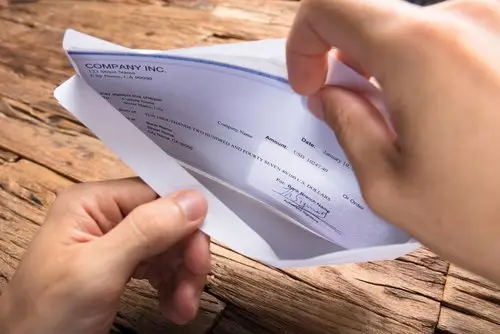
Wage statements (pay stubs) must include an itemized list showing your gross wages and net wages for the corresponding number of hours for the regular pay period, plus any deductions (such as for health insurance and taxes). In addition, California law requires that statements have:
- your full name and the last four digits of your social security number,
- your employer’s full name and physical address,
- the dates of the pay period,
- the total hours you worked,
- the number of hours worked at each hourly rate,
- the amount of units and rate for any piece-work, plus separate line items for rest/recovery periods and “other non-productive time” (paid at a rate at least equal to the minimum wage), if applicable, and
- the available amount of paid sick leave.4
The statement can be
- a separate document,
- a detachable pay stub, or
- viewable on your company portal.
You must be able to easily print or download these stubs. If the portal is behind a firewall that is not accessible if you are terminated, the employer is in violation.
If your employer uses a paperless system, they must provide you with a computer and a printer at the worksite so you can view and print your stubs during work hours at no cost to you. Furthermore, you must be able to access these records for at least three years after your employment ends.
Requesting Payroll Records
If you request your payroll records, your employer must let you examine them within 21 days. Your employer can charge reasonable copying costs if you want to keep a copy.
If your employer fails to honor your request in time, you may be entitled to an extra $750 from your employer.5
3. Late Paychecks
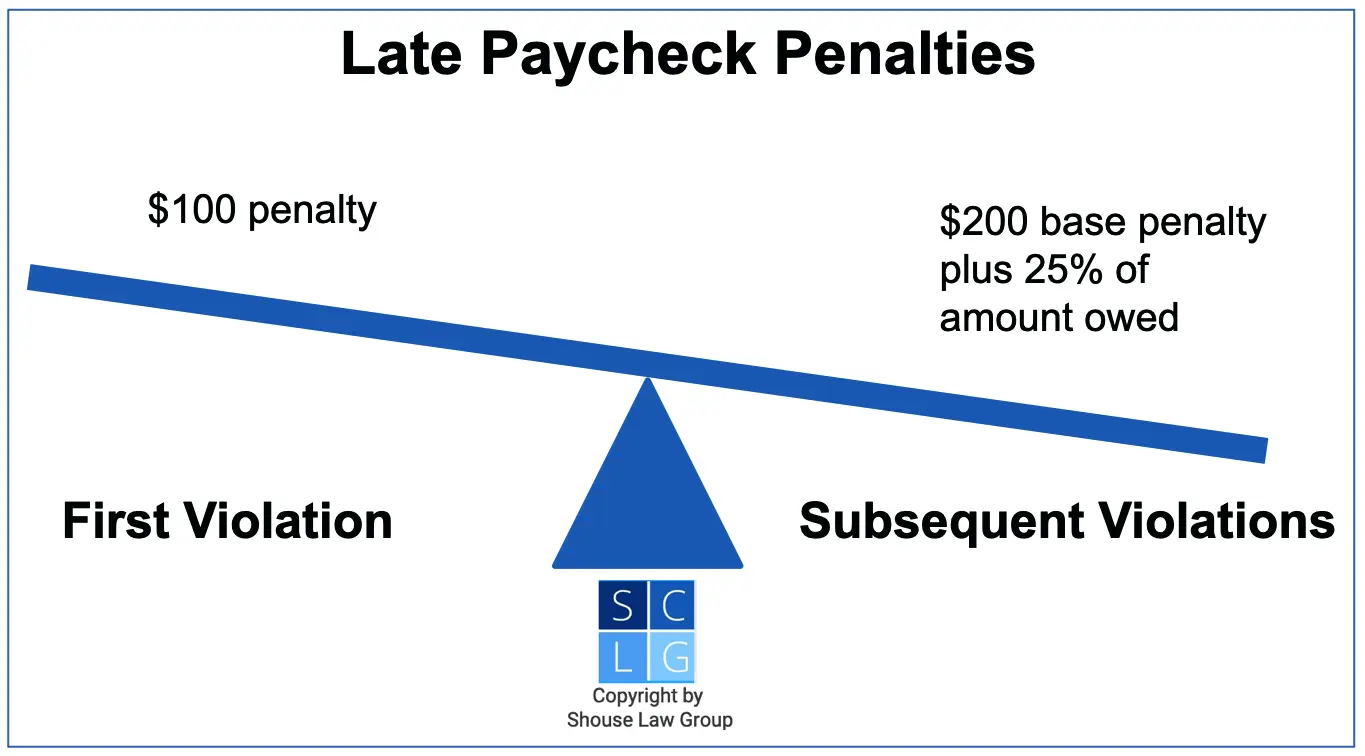
If your employer neglects to pay you on time, they owe you a $100 “statutory penalty” for a first violation ($200 if your employer willfully failed to pay you). All subsequent violations carry a statutory penalty of $200 plus 25% of the amount withheld from you.
Note that if your employer initiates a direct deposit on payday, but the bank doesn’t credit you until the next day, the employer is liable for a late payment penalty. “Payment” means access to funds and the power to withdraw them, not just the date on the check.
You can pursue statutory penalties by filing a wage claim with the California Labor Commissioner.6

4. Final Paychecks
If your employer terminates or lays you off, California law requires that you receive your final paycheck right away. Your final paycheck must include not only
- wages but also
- any unused vacation and paid time off (PTO).
If you quit or resign from a job without at least 72 hour’s notice, your employer has 72 hours to get you your final paycheck. Though if you quit with at least 72 hours’ notice, you must get your final paycheck on your last day.7
Penalty for Late Final Paychecks
If the employer is willfully late with your final paycheck, they have to pay you a penalty. The penalty amounts to a full day of wages for each day the final paycheck is late – up to 30 days.8
5. Federal Law
The main law is the Fair Labor Standards Act (FLSA), which is primarily enforced by the U.S. Department of Labor (DOL).
The FLSA sets forth pay schedule laws similar to those outlined above. Note that if a state law conflicts with federal law, an employer must follow the one that gives you the greatest protection.9

Frequently Asked Questions
What happens if my regular payday falls on a weekend or a holiday?
If your designated payday lands on a Saturday, Sunday, or a legal holiday, California law generally allows your employer to pay you on the next business day. However, many employers choose to pay on the Friday before to avoid any potential disputes. Check your company’s posted “Notice of Paydays” to see which policy they follow.
Can my employer hold my paycheck if I forget to submit my timecard?
No. Under California law, an employer must pay you for all hours they “knew or should have known” you worked, regardless of whether you submitted a formal timecard. While they can discipline you for failing to follow company procedure, they cannot legally withhold your wages as a penalty.
If I am paid by direct deposit, when must the funds be available?
For a payment to be considered “on time,” you must have access to the funds by the payday. If your employer initiates a direct deposit on Friday, but the bank does not credit your account until Saturday or Monday, the payment is technically late. “Payment” means the power to withdraw the money, not just the act of sending it.
Does my final paycheck have to include my unused sick leave?
No. While California law requires employers to pay out all earned, unused vacation or PTO (paid time off) in your final check, they are not required to pay out accrued sick leave unless your specific employment contract or a collective bargaining agreement says otherwise.
Additional Reading
For more in-depth information, refer to these scholarly articles:
- The timing of pay – Journal of Financial Economics.
- How Frequently do Private Businesses Pay Workers? – Bureau of Labor Statistics.
- Length of Pay Periods in American Industry – Monthly Labor Review.
- Piece work pay and hourly pay over the cycle – Labour Economics.
- Does paycheck frequency matter? Evidence from micro data – Journal of Financial Economics.
Also see our article on California paycheck laws.
Legal References:
- California Labor Code section 204. California Labor Code 204a and 204c. California Labor Codes 204a, 205.
- California Labor Code 204b. California Labor Code 207. California Labor Code 215.
- California Labor Code 201a. See also California Labor Code 204a. Sciborski v. Pacific Bell Directory (2012) 205 Cal.App.4th 1152. California Labor Code 205. California Labor Code 2810.5. California Labor Code 204. California Labor Code 207.
- California Labor Code 226.
- See note 1. California Labor Code 1198.5.
- California Labor Code 203. California Labor Code 210a. AB 673 (2019).
- California Labor Code 201.
- California Labor Codes 202a, 1194.2. Iloff v. LaPaille (Cal. 2025) 573 P.3d 1100 (employers cannot claim “good faith” simply because they were ignorant of the law; they must prove they made a reasonable effort to understand their legal obligations beforehand).
- 29 U.S.C. § 218(a). See also Aguilar v. Association for Retarded Citizens (1991) 234 Cal.App.3d 21.