
California Labor Code § 203 requires employers to pay a waiting time penalty when they fail to provide final paychecks to employees who are terminated or who quit. The penalty is equal to the employee’s daily wage for each day the final paycheck goes unpaid, up to 30 days.
The full text of the statute reads as follows:
203. (a) If an employer willfully fails to pay, without abatement or reduction, in accordance with Sections 201, 201.3, 201.5, 201.6, 201.8, 201.9, 202, and 205.5, any wages of an employee who is discharged or who quits, the wages of the employee shall continue as a penalty from the due date thereof at the same rate until paid or until an action therefor is commenced; but the wages shall not continue for more than 30 days.
An employee who secretes or absents themselves to avoid payment to them, or who refuses to receive the payment when fully tendered to them, including any penalty then accrued under this section, is not entitled to any benefit under this section for the time during which the employee so avoids payment.
(b) Suit may be filed for these penalties at any time before the expiration of the statute of limitations on an action for the wages from which the penalties arise.
Below our California labor law attorneys discuss Labor Code 203 in detail. Also listen to our informative podcast:
Legal analysis
Under California Labor Code 203 LC, employers who willfully fail to hand over a final paycheck are assessed a “waiting time penalty.” This penalty is equal to the employee’s daily rate of pay for each day the wages remain unpaid (up to 30 days).
|
Lateness with final paycheck |
Waiting time penalty |
| One to 30 days | Daily rate of pay multiplied by the number of days late |
| 31 days or longer | Daily rate of pay multiplied by 30 |
Note that former employees who purposely avoid receiving their final paycheck are not entitled to a waiting time penalty.1 Former employees who are entitled to waiting time penalties must file suit within three years in order to recover them.2
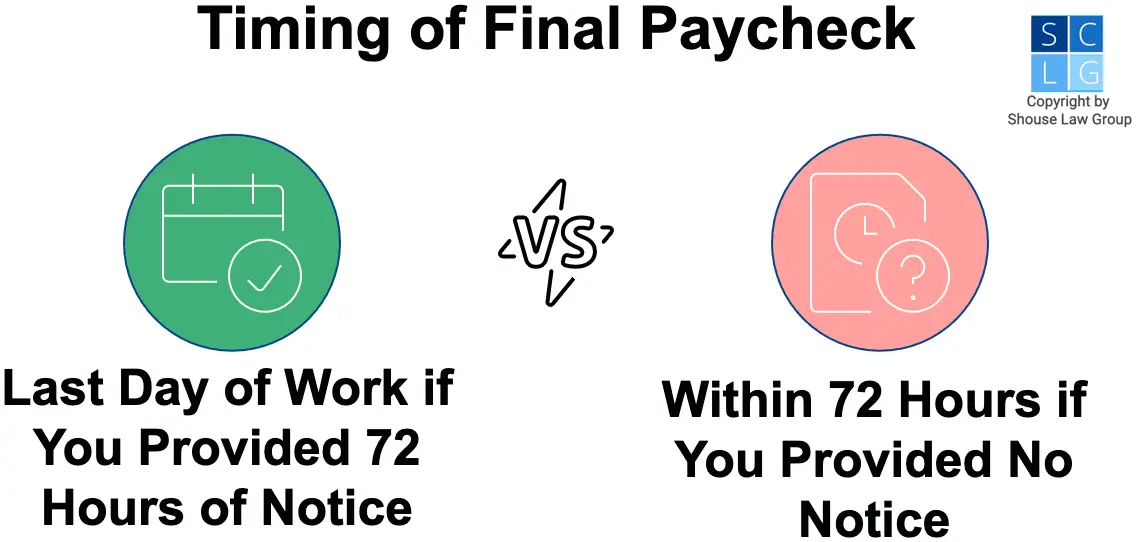
When employees quit without giving notice, employers have 72 hours to give them their final paycheck. When quitting employees give at least 72 hours of notice, then employers have to provide the final paycheck no later than their last workday. If the employees are fired or laid off, employers are required to provide final paychecks at the time of termination.3

Frequently Asked Questions
See our related article, What happens if my employer in California pays me late?
Legal References
- California Labor Code 203 LC – Penalty for willful failure to pay wages to discharged or quitting employee; Time for filing suit for penalties. See also: Road Sprinkler Fitters Local Union No. 669 v. G & G Fire Sprinklers, Inc. (Cal. App. 3d Dist., 2002), 102 Cal. App. 4th 765, 125 Cal. Rptr. 2d 804; Diaz v. Grill Concepts Services, Inc. (Cal. App. 2d Dist., 2018), 233 Cal. Rptr. 3d 524, 23 Cal. App. 5th 859.
- Pineda v. Bank of America (2010) 50 Cal.4th 1389.
- LC 202.