In California, an employee misclassification lawsuit is a civil case in which you argue that your employer misclassified you to avoid paying overtime or other payroll benefits. If your lawsuit is successful, you can recover your unpaid wages as well as the benefits that you did not receive.
In this article, I discuss what you need to know about employee misclassification and bringing a lawsuit in California.
Types of Misclassification
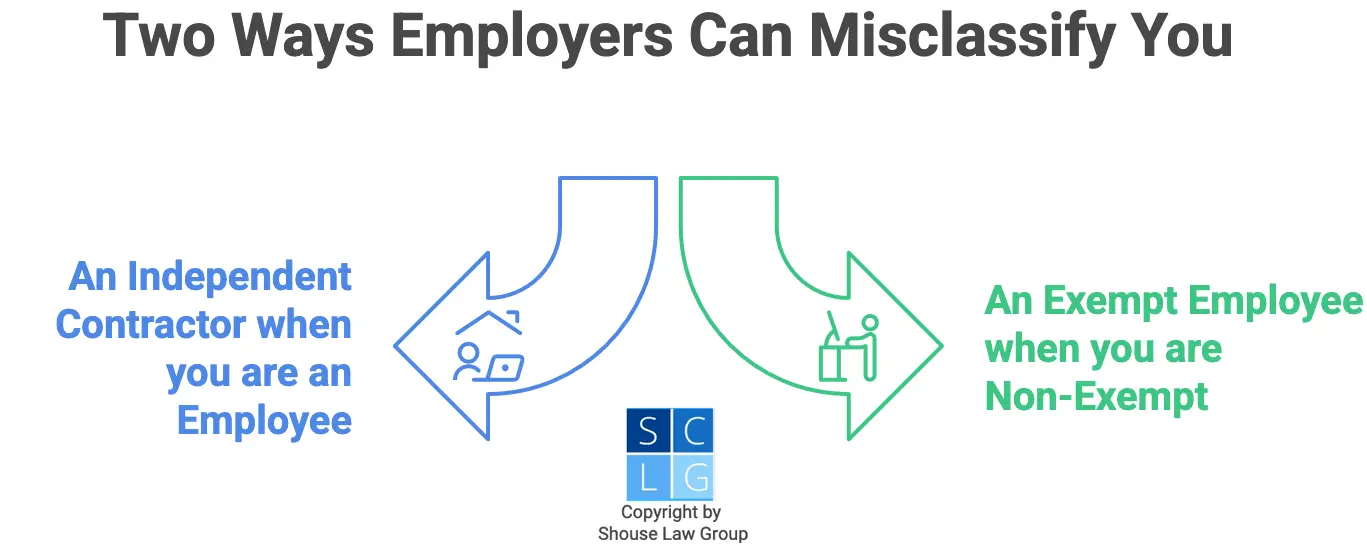
In California, it is unlawful for your employer to misclassify you:
- as an independent contractor when you are actually an employee or
- as an exempt employee when you are actually non-exempt.
Employers do this to:
- save money on paying you benefits,
- save money paying Medicare and Social Security taxes to the IRS, and/or
- deprive you of your rights and legal protections in the workplace.
The lawyers at our firm have found that some employers systematically misclassify workers. With so many workers misclassified, the case could become a class action, potentially involving thousands of plaintiffs.
Independent Contractor Misclassification Lawsuits
Independent contractor misclassification occurs when your employer pays you like an independent contractor but treats you like an employee.
What are independent contractors?
Unlike non-exempt employees, independent contractors are not entitled to:
- the minimum wage,
- overtime pay,
- meal and rest breaks, and
- other workplace benefits, like health insurance, vacation time, medical leave, and workers’ compensation.
Meanwhile, independent contractors – unlike employees – are entitled to control how their work is performed, such as by:
- setting their own hours,
- using their own equipment, and
- working for other clients.
It is not uncommon for employers to require workers to sign employment contracts stating they are independent contractors, yet treat them as employees. Fortunately, employment contracts are not the last word.
ABC Test
To distinguish between employees and independent contractors, California relies on the “ABC test.” This test ignores what the employment contract may say and instead examines:
- the control your employer exerts over you,
- whether the work you do is outside the company’s typical business, and
- whether you normally provide this type of work as an independent business.1
According to the California Labor & Workforce Development Agency:
“Under the ABC test, a worker is considered an employee and not an independent contractor, unless the hiring entity satisfies all three of these conditions.”2
Exempt Employee Misclassification
To be an exempt employee in California, you generally have to fall into a specific category, such as:
- white-collar professionals,
- licensed professionals,
- outside salespeople, or
- computer professionals.
Each category has its own requirements. For example, “white-collar professional” must:
- be primarily engaged in executive, administrative, or professional duties,
- regularly and customarily exercise independent judgment and discretion in your job, and
- earn a salary of at least twice the state minimum wage for full-time work.3
Employers often misclassify non-exempt employees as exempt to avoid having to extend certain workplace rights and protections, such as:
- extra pay for overtime work,
- the minimum wage for hours worked, and
- meal and rest breaks.
We find that employers try to use job titles to make it seem as if a non-exempt role is actually exempt. An example is calling data entry clerks “administrative executives” to make it appear they fall under the white-collar exemption.
Employment Contracts as Evidence of Misclassification
Whether you are an employee or an independent contractor is based on how your employment relationship actually works, not on what the employment contract says. Just because your employment contract states that you are an independent contractor or an exempt employee does not end the case.
If you are being misclassified as an independent contractor or as an exempt employee, your employment contract will serve as valuable evidence in a California lawsuit.

Misclassification Remedies
If you win a misclassification lawsuit in California, you may be able to recover:
- unpaid wages,
- pay for missed rest or meal breaks,
- compensation for deprived employee benefits, like expense reimbursements or unemployment insurance,
- interest on missed payments, and
- attorneys’ fees.
If you were misclassified as exempt, federal law entitles you to liquidated damages, or double damages.4 You would recover the full amount of your unpaid wages, plus the same amount again.
If you were deliberately misclassified as an independent contractor, California law requires your employer to pay a civil penalty of $5,000 to $25,000 per violation.5
Note that if you get terminated for questioning your employment status, you may be able to file a wrongful termination claim.
Common Misclassification Cases
Workers in the gig economy are most frequently misclassified as independent contractors. This includes people who work for companies with business models that distance themselves from the people who work for them, such as:
- Uber,
- Lyft,
- DoorDash, and
- Uber Eats.
Even outside of the gig economy, though, worker misclassification is common. Examples include jobs like:
- photographers,
- writers,
- editors,
- web designers,
- artists, and
- other freelancers.
Additional Resources
For more information, refer to the following:
- Who’s an Independent Contractor? Who’s an Employee? – Scholarly article in The Labor Lawyer.
- Independent Contractor Defined – Summary by the Internal Revenue Service (IRS).
- What is an Independent Contractor – Overview from Business News Daily.
- Misclassification of Employees as Independent Contractors – Discussion by the U.S. Department of Labor, Wage and Hour Division.
- Independent Contractor Status Under the Fair Labor Standards Act – In-depth discussion from the Federal Register.
Legal References
- See California Labor Code 2775 LAB and Espejo v. The Copley Press, Inc. (2017) 13 Cal.App.5th 329. Under federal regulations by the U.S. Department of Labor (DOL), the Fair Labor Standards Act (FLSA) uses the “economic realities test.” This test looks at all of the circumstances, but pays close attention to the following six factors: 1) whether you have the opportunity to experience profit or loss based on your managerial skill, 2) the extent of the investments made by you and your potential employer, 3) whether the working relationship is a permanent or indefinite one, 4) the nature and the degree of control that the potential employer has over you, 5) the extent to which the work being done is integral to the potential employer’s business, and 6) whether you are using special skills or initiative. Some states use the economic realities test as well.
- California Labor & Workforce Development Agency, “What is the ABC test?”
- 8 California Code of Regulations (CCR) 11040(1)(A).
- 29 USC 216(b).
- California Labor Code 226.8 LAB.