In California, you are considered a full-time employee if you work 40 or more hours in a week.1 This entitles you to certain workplace benefits.
However, some federal laws define “full-time work” in a way that requires fewer hours on the job. Under these laws, you could be entitled to healthcare or retirement benefits without working 40 hours per week.
In this article, I discuss what you need to know about full-time vs. part-time work in California.
Full-Time Status
A full-time employment status does several things in California. It:
- sets the minimum wage for full-time exempt employees,
- sets the limit of hours non-exempt employees can work before they are entitled to overtime pay, and
- provides other legal protections and entitlements.
1. Minimum Wage
California labor laws provide lots of legal protections for workers. However, employers can exempt specific jobs from some of these protections by satisfying several requirements.
One of those requirements is that the exempt employee makes at least twice the minimum wage for full-time employment.2
In California, the state-wide minimum wage as of January 1, 2026, is $16.90 per hour.3 Over a 40-hour workweek, this amounts to $35,152 per year. This means that you would have to make at least twice that – $70,304 per year – to be classified as a full-time exempt employee.
2. Overtime Pay
In California, full-time non-exempt workers are entitled to overtime pay for working more than 40 hours in a workweek. Employers must also pay non-exempt employees for work done in excess of:
- 8 hours in one day of work or
- 6 consecutive workdays in a workweek.4
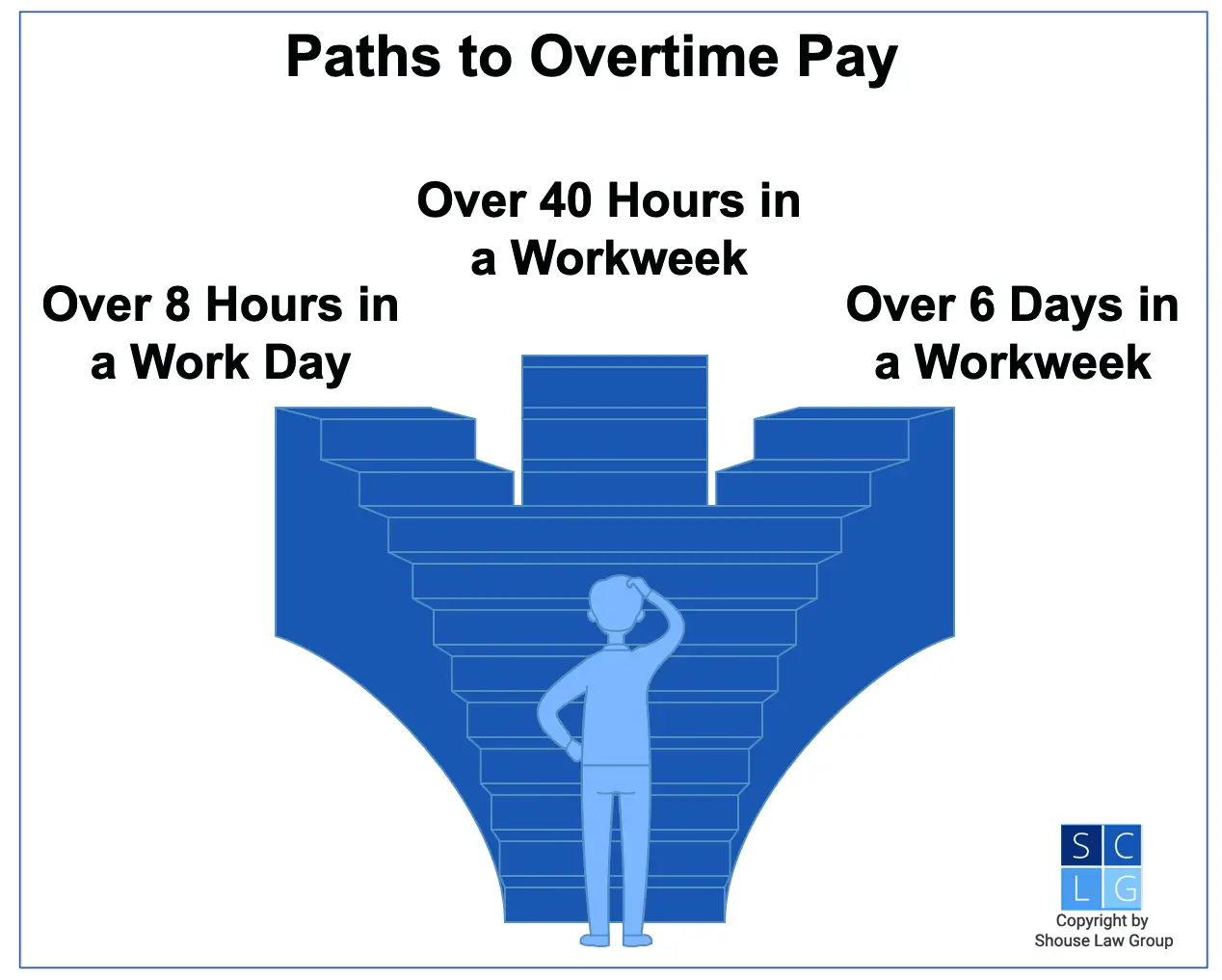
Any hours worked in excess of these limits are paid at one-and-a-half times, or 1.5 times, the employee’s regular rate of pay.5
Non-exempt workers could also be entitled to double time pay if the employer makes them work
- more than 12 hours in a workday or
- more than 8 hours on the seventh consecutive day in a workweek.
Note that non-exempt workers are also entitled to an unpaid 30-minute meal break for every five hours of work and a paid 10-minute rest break for every four hours of work.6
3. Worker Protections
Full-time workers also often receive other workplace entitlements and benefits, such as:
- sick leave,
- vacation time,
- parental leave,
- holiday pay,
- other paid time off (PTO), like personal days,
- health insurance,
- dental insurance,
- disability insurance,
- life insurance,
- retirement plans,
- a fixed work schedule, and
- preservation of payroll records for three years.
Increasingly, though, employers have been offering some of these benefits to part-time workers as well. This is generally done to:
- decrease worker turnover,
- attract better or more dedicated workers,
- reduce worker burnout, and
- improve worker morale.

Federal Law
Some federal laws use different definitions of “full-time employment” when providing worker benefits. This can create confusion, as you may be a full-time worker for one set of benefits but not for others. Two of these laws are the:
- Employee Retirement Income Security Act (ERISA), and
- Affordable Care Act (ACA).
The confusion stems from the lack of a federal law defining “full-time employment.” No federal law, not even the Fair Labor Standards Act (FLSA), sets the number of hours for full-time employment.
ERISA
The Employee Retirement Income Security Act, or ERISA, makes you eligible to participate in employer-provided retirement plans if you are a full-time employee.
Under ERISA, though, you are a “full-time employee” if you work 1,000 hours or more in a year. This is slightly less than 19.5 hours per week.7
ACA
The Affordable Care Act (ACA), or Obamacare, requires all employers with 50 or more full-time employees to offer their full-time employees healthcare benefits.
Under the ACA, a full-time employee is someone who works more than 30 hours in a workweek or more than 130 hours a month.
Small employers (with fewer than 50 full-time employees) decide who gets benefits. However, if offered to full-time employees, the standards for receiving those benefits must be the same for everyone.8
Part-Time Work
There is no legally binding definition of a “part-time employee” in California. It is generally left up to the employer to define what “part-time” means.
While the Labor Market Information Division of the California Employment Development Department states that part-time work is less than 35 hours, this is only used to calculate employment statistics. It is not legally binding in the state.
Part-time workers often receive fewer benefits than full-time workers do.
Even if you are part-time, though, you do still have rights to:
- the applicable minimum wage,
- rest periods and meal breaks, and
- freedom from harassment or discrimination in the workplace.
If your employer calls your job part-time but demands full-time hours of work, you can file a misclassification lawsuit. An employment lawyer can help you recover unpaid wages and other forms of compensation.
Frequently Asked Questions
Is 32 hours a week considered full-time in California?
It can be. California law does not have a universal definition of full-time employment that applies to every situation. While Labor Code section 515 defines full-time employment as 40 hours per week for certain wage-and-hour purposes, many employers consider employees who work 32 to 35 hours per week to be full-time for benefits and scheduling purposes.
Is 30 hours a week considered full-time in California?
Sometimes. Under the federal Affordable Care Act (ACA), an employee who works at least 30 hours per week or 130 hours per month is generally considered full-time for employer-sponsored health insurance purposes.
However, California wage-and-hour laws often use a 40-hour workweek as the benchmark for full-time employment.
Can my employer classify me as part-time even if I work 40 hours a week?
In many cases, yes. California law does not prohibit employers from labeling workers as part-time. However, employers must still comply with all wage-and-hour laws, including overtime requirements.
In addition, an employer may violate its own policies or benefit plans if it denies benefits to employees who satisfy the company’s full-time eligibility requirements.
Do full-time employees automatically get health insurance in California?
No. California law generally does not require employers to provide health insurance solely because an employee is full-time. However, larger employers may have obligations under federal law to offer health coverage to eligible full-time employees or potentially face penalties.
Do full-time employees automatically get paid vacation?
No. California employers are not required to provide paid vacation. However, if an employer chooses to offer vacation benefits, earned vacation time is treated as wages and generally cannot be forfeited under a “use-it-or-lose-it” policy.
Do full-time employees get paid holidays in California?
Usually not. California law generally does not require private employers to provide paid holidays. Whether employees receive holiday pay depends on the employer’s policies, employment contract, or collective bargaining agreement.
Do part-time employees get paid sick leave in California?
Yes. Most employees in California—including part-time, temporary, and seasonal workers—are entitled to paid sick leave if they work for the same employer for at least 30 days within a year and otherwise meet the requirements of the state’s paid sick leave law.
Can part-time employees earn overtime in California?
Yes. California overtime laws apply regardless of whether an employee is classified as full-time or part-time. A non-exempt employee who works more than 8 hours in a workday or more than 40 hours in a workweek may be entitled to overtime pay.
What is the difference between full-time status under California law and under the Affordable Care Act?
California employment laws and the Affordable Care Act use different standards. California wage-and-hour laws often use a 40-hour workweek as the benchmark for full-time employment, while the ACA generally considers employees full-time if they work at least 30 hours per week or 130 hours per month.
Are full-time employees entitled to more legal protections than part-time employees?
Generally, no. Most California labor laws—including minimum wage laws, overtime laws, meal and rest break requirements, anti-discrimination protections, and paid sick leave rights—apply to both full-time and part-time employees. The primary differences usually involve employer-provided benefits rather than legal protections.
Can an employer reduce my hours to avoid making me full-time?
Employers generally have broad discretion to set employee schedules. However, an employer cannot reduce hours for an unlawful reason, such as retaliation for exercising workplace rights, taking protected leave, reporting labor violations, or engaging in legally protected activities.
What should I do if my employer is misclassifying my employment status?
You may want to review your employer’s handbook, benefits policies, and employment agreements to determine how the company defines full-time status. If you believe your employer is improperly denying benefits or violating California labor laws, you may wish to consult an employment lawyer or file a complaint with the appropriate government agency.
Additional Reading
For more in-depth information, refer to these scholarly articles:
- Job attitudes of part-time vs. full-time workers: A meta-analytic review – Journal of Occupation and Organizational Psychology.
- Reconceptualizing the Nature and Consequences of Part-Time Work – Academy of Management Review.
- Why Do Part-Time Workers Earn Less? The Role of Worker and Job Skills – ILR Review.
- Voluntary Part-Time Workers: A Growing Part of the Labor Force – Monthly Labor Review.
Legal References
- California Labor Code 515(c) LAB. One of the first companies to adopt a 40-hour, five-day work week was the Ford Motor Company on May 1, 1926. The policy was first applied to automotive factory workers (“blue-collar) and then to office workers (“white-collar”). Twelve years later in 1938, Congress passed the Fair Labor Standards Act, which mandated companies pay overtime pay when employees worked more than 44 hours a workweek; then in 1940, it was amended down to more than 40 hours a workweek.
- California Labor Code 515(a) LAB. Generally speaking, exempt employees are paid salaries while non-exempt workers are paid hourly. See also the FLSA, which sets out exemptions for certain types of jobs, such as employees in executive, computer, outside sales, or administrative positions.
- California Labor Code 1197 LAB.
- California Labor Code 510 LAB.
- Same. See also the FLSA, which also sets overtime pay at 1.5 times straight pay.
- Same. Labor Code 512. 8 California Code of Regulations (“C.C.R”) 11040. See also Bradsbery v. Vicar Operating, Inc. (2025) 110 Cal.App.5th 899 (Employee rights often depend on the hours actually worked rather than the employer’s classification of the worker.); Mora v. C.E. Enterprises, Inc. (Cal. App. 2025) No. B337830 (focus on actual work performed rather than job titles or classifications).
- 29 CFR 1052.
- 79 Fed. Reg. 8581 (Feb. 12, 2014).