
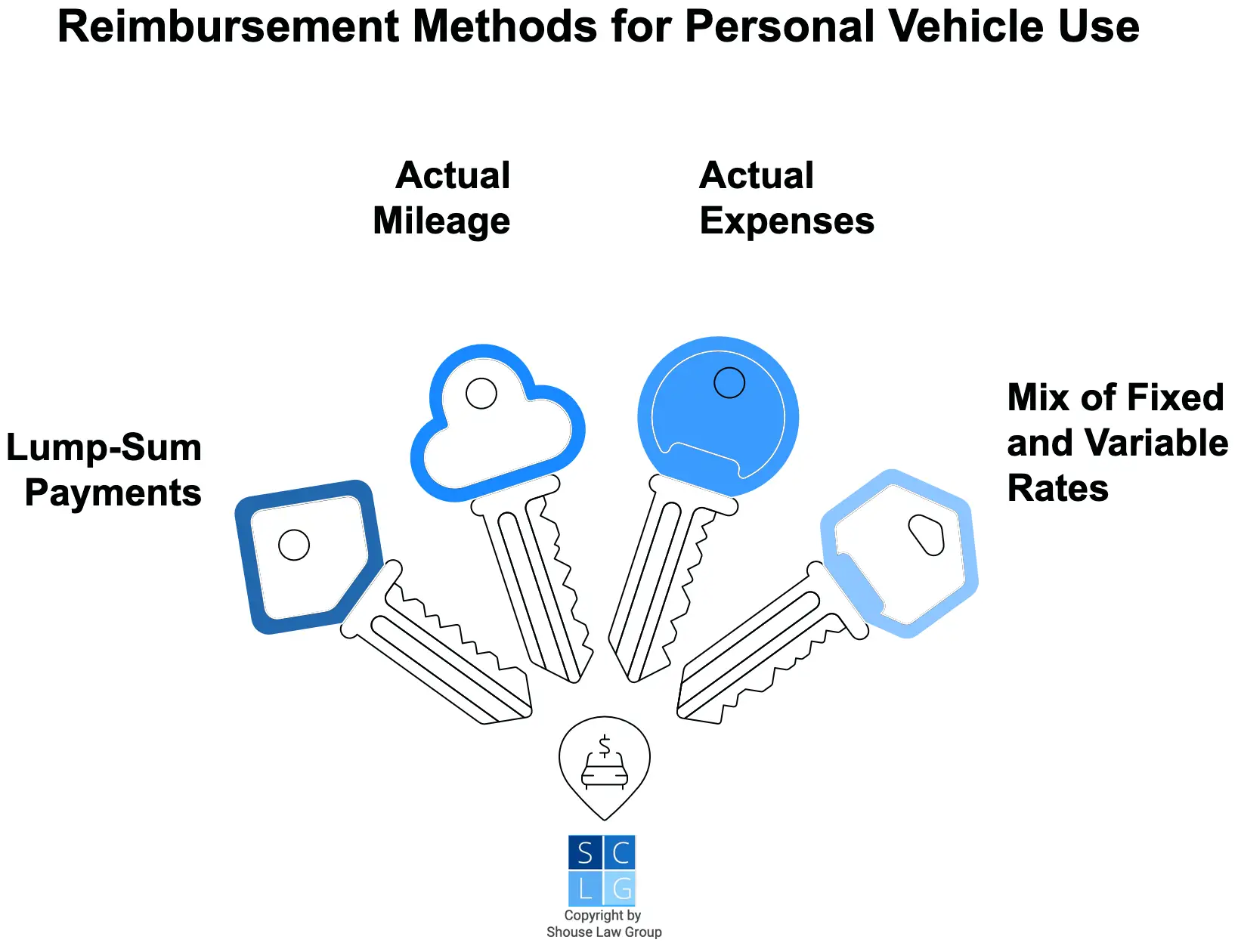
In California, employers are required to fully reimburse you when you use your personal vehicles for business purposes. In total, there are 4 ways to calculate your reimbursement:
- Lump-sum payments,
- Actual mileage,
- Actual expenses, or
- A mixture of fixed and variable rates.
Many employers adopt the IRS’s reimbursement rates, which go by actual mileage, as the following table shows.1
|
Purpose of Using Your Personal Vehicle |
IRS Reimbursement Rate |
| Business use | $0.72.5 per mile |
| Active-duty members moving or getting medical treatment | $0.20.5 per mile |
| In service of a charity | $0.14 per mile |
These four methods of reimbursement are discussed in detail below.
1. Lump-Sum Payments
California employers are allowed to use a lump sum payment to reimburse you for job-related vehicle expenses. Also referred to as
- a “gas stipend,”
- a “car allowance,” or
- a “per diem,”
this is a regular payment, often made monthly, of a set amount that has been deemed adequate to cover your expenses.
The lump-sum method is generally used if you drive your personal vehicles on the same routes every day or week. When the amount being driven remains the same, lump-sum payments can be ideal because they reduce the amount of record-keeping that you have to do.
However, fluctuating gas prices can make a lump sum payment inadequate. In these cases, you can challenge the amount and demand full reimbursement.2
2. Actual Mileage
Your employer and you can agree on a per-mile reimbursement rate. You can:
- adopt the mileage reimbursement rate suggested by the IRS or by the California Department of Human Resources (which for 2026 is $0.72.5 per mile) or
- agree to your own rate.
However, the rate agreed to has to compensate you for work-related travel expenses fully, and you must also be allowed to challenge the rate if you believe that it is inadequate. Plus, your mileage reimbursement should not be taxed as income unless your employer pays you more than the current IRS reimbursement rate.
If you use your personal vehicles for business purposes, you will have to track your mileage. This can be difficult to keep up.3

3. Actual Expenses
This method of calculation requires you to record the exact amount of all of the losses paid while driving on the job, including:
- the cost of refilling the tank after every day of work,
- year-over-year changes in the vehicle’s resale value to determine depreciation, and
- maintenance costs from work-related driving.
While reimbursements based on the actual expense method is the most accurate, the record-keeping requirements for this method of reimbursement are onerous. Plus, disputes with your employer can arise over, for example, which auto repair shop you use.4
4. A Mixture of Fixed & Variable Rates
A fixed and variable rate reimbursement (FAVR) splits the fixed costs of using a personal vehicle for business use, like insurance rates, from the variable costs, like gas.
The fixed costs are then reimbursed on an individual basis to an agreed-upon amount. The variable costs are reimbursed based on an agreed mileage rate.
Frequently-Asked-Questions about Mileage Reimbursements in California
What is included in mileage reimbursements?
- gasoline costs
- vehicle depreciation from wear and tear,
- maintenance and repair costs,
- vehicle registration fees, and
- car insurance.
California’s mileage reimbursements do not include your daily commute to and from the workplace. Instead, it covers any errands related to work, such as:
- Driving to meet with customers, clients, and other co-workers,
- Driving to conferences,
- Driving to stores to buy supplies, and/or
- Driving to banks for business-related reasons, such as deposits.
Plus the reimbursement has to cover only your necessary and reasonable expenses. Unnecessary vehicle expenses do not have be covered.5
Do I get a separate paycheck for mileage reimbursements?
Mileage reimbursements do not have to be paid separately from your wages or other compensation. However, your paycheck does have to show that it includes the mileage reimbursement.6
Can I waive my right to mileage reimbursements?
No. Any agreement that waives your right to full reimbursement of your job-related vehicle expenses is void.7
What is my employer’s mileage reimbursement policy?
It is up to your employer and you to agree on which reimbursement policy will be used. If a mileage reimbursement system is used, you have to agree on the rate per mile. This is generally set out in your:
- employment contract or
- employee handbook.
Which method of mileage reimbursement is the best?
They all have advantages and disadvantages.
The mileage reimbursement method is more accurate than a lump sum agreement or gas stipend. However, it still does not account for rising or falling gas prices.
Many people prefer the FAVR system since the mileage rate can change based on local gas prices. This adds to the accuracy of a FAVR reimbursement mechanism.
What if my employer is underpaying my personal vehicle expenses?
If your employer is underpaying you for the personal use of your vehicles, you can challenge the amount that has been reimbursed. By using evidence of your actual costs, you can show that the reimbursement has been inadequate.
If your employer does not correct the discrepancy, you can file a wage and hour lawsuit. If your fellow employees are also being underpaid, you can try to file a class-action lawsuit.

Additional Resources
For more information, refer to the following:
- 6 Commonly Asked Questions About Employee Mileage Reimbursement – General information by the U.S. Chamber of Commerce.
- Mileage Reimbursement: What You Need to Know – Informational article for employees and employers by Business News Daily.
- Travel Reimbursements – Information about current mileage reimbursement rates by the California Department of Human Resources.
- Standard Mileage Rates – Information about mileage reimbursement rates for the current year provided by the Internal Revenue Service (IRS).
Legal References:
- California Labor Code 2802(a) LAB, which makes employers reimburse you for all necessary expenses or losses incurred in direct consequence of the discharge of your duties, or your obedience to the employer’s directions. You are entitled to reimbursement even if your employer’s orders were unlawful, unless you believed that they were unlawful while doing them. IRS increases the standard mileage rate for business use in 2026, IRS.
- Gattuso v. Harte-Hanks Shoppers, Inc., (2007) 42 Cal.4th 554 (“We conclude that an employer may satisfy its statutory business expense reimbursement obligation under section 2802 by paying employees enhanced compensation in the form of increases in base salary or commission rates, provided the employer establishes some means to identify the portion of overall compensation that is intended as expense reimbursement, and provided also that the amounts so identified are sufficient to fully reimburse the employees for all expenses actually and necessarily incurred.”).
- Same.
- Same.
- Gattuso v. Harte-Hanks Shoppers, Inc., (2007) 42 Cal.4th 554. Espejo v. The Copley Press, Inc. (), . Oliver v. Konica Minolta Business Solutions U.S.A., Inc. ( See also Division of Labor Standard Enforcement (DLSE) Opinion Letter No. 1993.02.22-3.
- See note 2.
- Same. California Labor Code 2804 LAB.