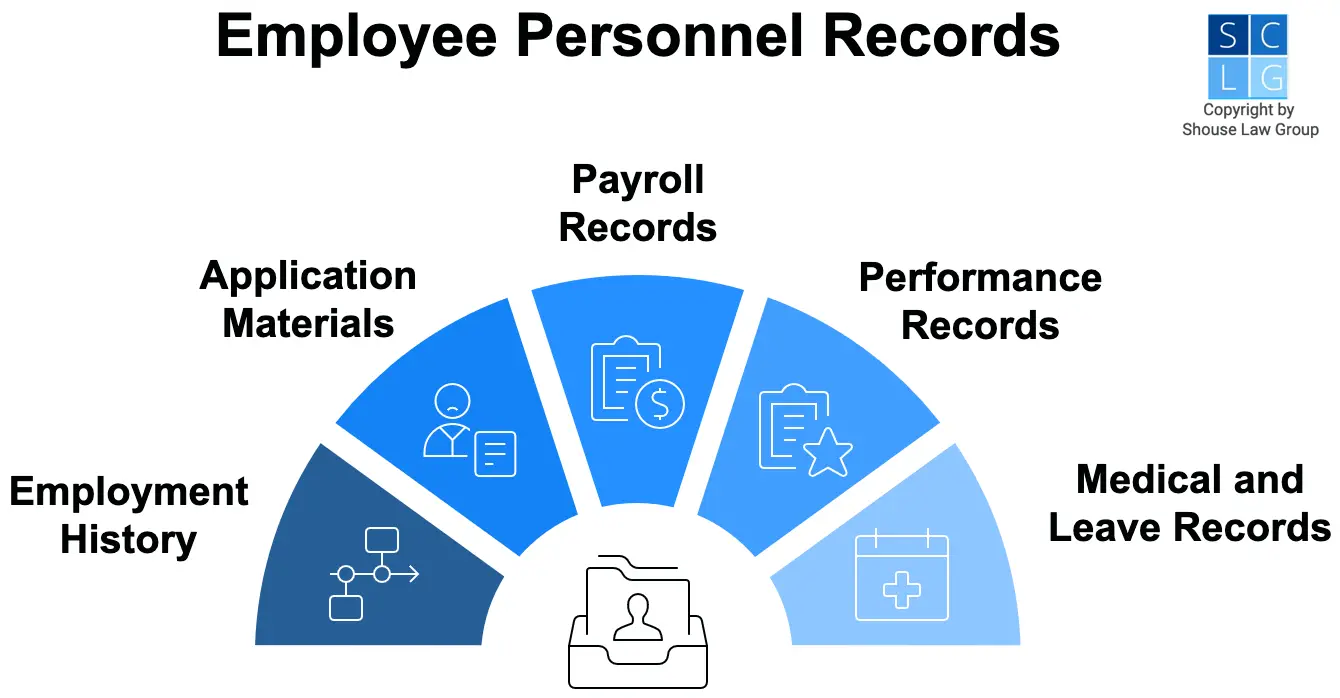
An employment records request refers to your right under California Labor Code 1198.5 to ask your past or present employer for your personnel records. This includes your:
- applications for employment,
- payroll records, and
- performance evaluations.
You can request your payroll records orally, though you usually must request your full personnel records in writing via:
- letter,
- email,
- fax, or
- a records request form provided by your employer.
You can exercise an employment records request anytime for almost any reason. Many requests are made in relation to a claim of wrongdoing by the company, such as
- age discrimination,
- race discrimination,
- wrongful termination, or
- the violation of a wage and hour law.
If your employer fails to comply with your records request, you are entitled to a $750 fine.
Our California labor and employment lawyers will highlight the following in this article:
- 1. Your Rights
- 2. Timing of Request
- 3. Making a Request
- 4. Employer Penalties
- 5. Federal Law
- Additional Resources
1. Your Rights
California Labor Code Section 1198.5a is the state law that sets forth your basic rights regarding record requests.
That statute reads:
“Every current and former employee, or his or her representative, has the right to inspect and receive a copy of the personnel records that the employer maintains relating to the employee’s performance or to any grievance concerning the employee.”1
You must make your request in writing.2 Note, however, that a written request is not necessary when you seek certain payroll records: An oral request in these cases is sufficient.3
State laws say that employers must respond to record requests within 30 calendar days after the date it receives the request.4 Any requests for payroll records must be provided within 21 days.5

Your Personnel Records
California’s Labor Code does not specifically define the term “personnel records.” Though your right to request items in a personnel file often includes the right to examine the following:
- records relating to your employment history,
- an application for employment and offer letters,
- payroll authorization forms and wage records/statements,
- warnings or notices of commendation,
- notices of a disciplinary action,
- records relating to your qualifications for additional compensation,
- attendance records,
- performance evaluations and reviews,
- education and training records,
- notices of wage garnishments,
- medical records if related to an employment situation (such as an injury causing a worker’s compensation claim or a drug test),
- notices of layoff, vacation or leaves of absence,
- arbitration agreements, and
- notices of termination.
An employer must redact any confidential information (such as your social security number) in these records prior to an employer’s examination of the record. (Note that any medical records should be stored in a confidential file separate from your personnel records.)
Exceptions to Records Request Rules
State law says that the above rules regarding requests do not apply to:
- records relating to the investigation of a possible criminal offense,
- letters of reference,6
- records related to employees protected by the Public Officers Procedural Bill of Rights or subject to the Information Practices Act of 1977, and
- ratings, reports, or records that were:
- obtained prior to your employment.
- prepared by identifiable examination committee members.
- obtained in connection with a promotional examination.7
Also, if you are subject to a collective bargaining agreement, the agreement may lay out its own records request rules that override Labor Code 1198.5.
How Long Your Employer Keeps Your File
Employers must maintain a copy of your personnel file for:
- a period of not less than three years after termination of employment or
- a reasonable period beyond that time.8
2. Timing of Request
You can exercise an employment records request at any time for almost any reason.
However, many requests are made in relation to a (potential) lawsuit or a claim of wrongdoing, including claims of:
- age discrimination,
- coworker harassment,
- disability discrimination,
- teacher misconduct,9
- gender discrimination,
- defamation,
- sexual harassment,
- preventing a promotion or the failure to promote,10
- supervisor harassment,
- bullying, and
- wrongful termination.
Note that if you are a former employee, your former employer does not have to comply with more than one record request per year.11

3. Making a Request
There are a few key practical tips that you should consider when drafting a request for employment records.
The “written” request can take the form of:
- a letter,
- an email, or
- fax.
Your employer may already have a records request form you can fill out in the office or online, so check your employee handbook for details.
The request should be brief (a few short paragraphs) and straightforward. You have a right to make this request. This means it does not have to explain in detail all of the reasons for the records sought. Just a few will suffice.
You have to keep a professional tone in asking for records. Mean or angry language should be excluded.
Further, it is a good idea for you to do the following:
- address or send the “writing” to human resources or a supervisor,
- include your job title,
- clearly state the specific document(s) being sought, and
- keep a copy of the request.
Sample Records Request Email
| Subject line: Request for copies of my employment records
Dear HR Department, I request copies of my personnel records. Specifically, I request:
I look forward to receiving copies soon at [insert mail or email address] Thank you, [your name] |
4. Employer Penalties
It is an infraction for employer to fail to comply with a records request under California Labor Code 1198.5. The penalty is a $750 paid to you.12
You can also file an injunction against the employer. An injunction, if successful, compels the employer to comply with the request. If you file for injunctive relief, you can recover:
- any legal costs incurred and
- reasonable attorney’s fee.13
Note that Labor Code 432 makes it a misdemeanor – which is more serious than an infraction – if your business fails to comply with your request for any documents that you signed relating to obtaining or holding of employment. Examples of such documents include:
- job applications,
- job contracts,
- tax withholding instruments,
- direct deposit forms,
- time cards,
- policy acknowledgments,
- non-compete agreements,
- employee complaints you submitted, and/or
- performance reviews or warnings.
Although Labor Code 432 does not specify a time limit for producing these documents, it is presumably 30 days – the same as for records requests under Labor Code 1198.5.14
5. Federal Law
There are no federal laws in the United States that give you a right to look at your personnel files.
Most states, though, give you this right under state statutes.
Additional Resources
For more information, refer to the following:
- Personnel Files and Records – Overview of state law by the California Department of Industrial Relations.
- Rights in the Workplace: Access to Personnel Files – Article in Public Affairs Quarterly.
- The Confidentiality of Personnel Records: A Legal and Ethical View – Article in Lab. Law Journal.
- Employee and government access to personnel files: rights and requirements – Article in Employee Relations Law Journal.
- Confidentiality of Personnel Files in the Private Sector – Article in U.C. Davis Law Review.
Legal References:
- California Labor Code 1198.5a. See also California Labor Code 1198. See also, for example, Taylor v. Tesla, Inc. (Cal.App. 2024) . SB 513 (2025)(increases the personnel records which employers have to make available to employees for inspection to also comprise education and training records).
- California Labor Code 1198.5b2.
- California Labor Code 226c.
- California Labor Code 1198.5b1.
- California Labor Code 226c.
- See, for example, Board of Trustees v. Superior Court of Santa Clara County (1981) 119 Cal.App.3d 516; and, Williams v. Superior Court (2017) 3 Cal.5th 531.
- California Labor Code 1198.5h.
- California Labor Code 1198.5c1.
- Associated Chino Teachers v. Chino Valley Unified School Dist. (2018) 30 Cal.App.5th 530.
- Board of Trustees v. Superior Court of Santa Clara County, supra. Brutsch v. City of Los Angeles (1992), 3 Cal.App.4th 354.
- California Labor Code 1198.5d.
- California Labor Code 1198.5k.
- California Labor Code 1198.5l.
- California Labor Code 432 and 433.