A California labor board complaint is where you ask the state to investigate an employment dispute involving improper actions by your employer. The two labor boards that hear employment grievances are:
- the Labor Commissioner with the Department of Industrial Relations (DIR), which handles wage and hour complaints and labor violations such as retaliation; and
- the Civil Rights Department (CRD), which handles discrimination and harassment cases.
Here at (877) SUE-MY-BOSS, we have helped countless victims of wage and hour violations and workplace harassment/discrimination to recover substantial financial settlements.
In this article, our California labor and employment attorneys address the following key issues regarding filing labor board complaints:
- 1. How to File
- 2. Common Complaints
- 3. Labor Commission
- 4. Civil Rights Department
- 5. Retaliation
- 6. Statute of Limitations
- 7. Contact the Labor Board
- Frequently Asked Questions
- Additional Resources
1. How to File
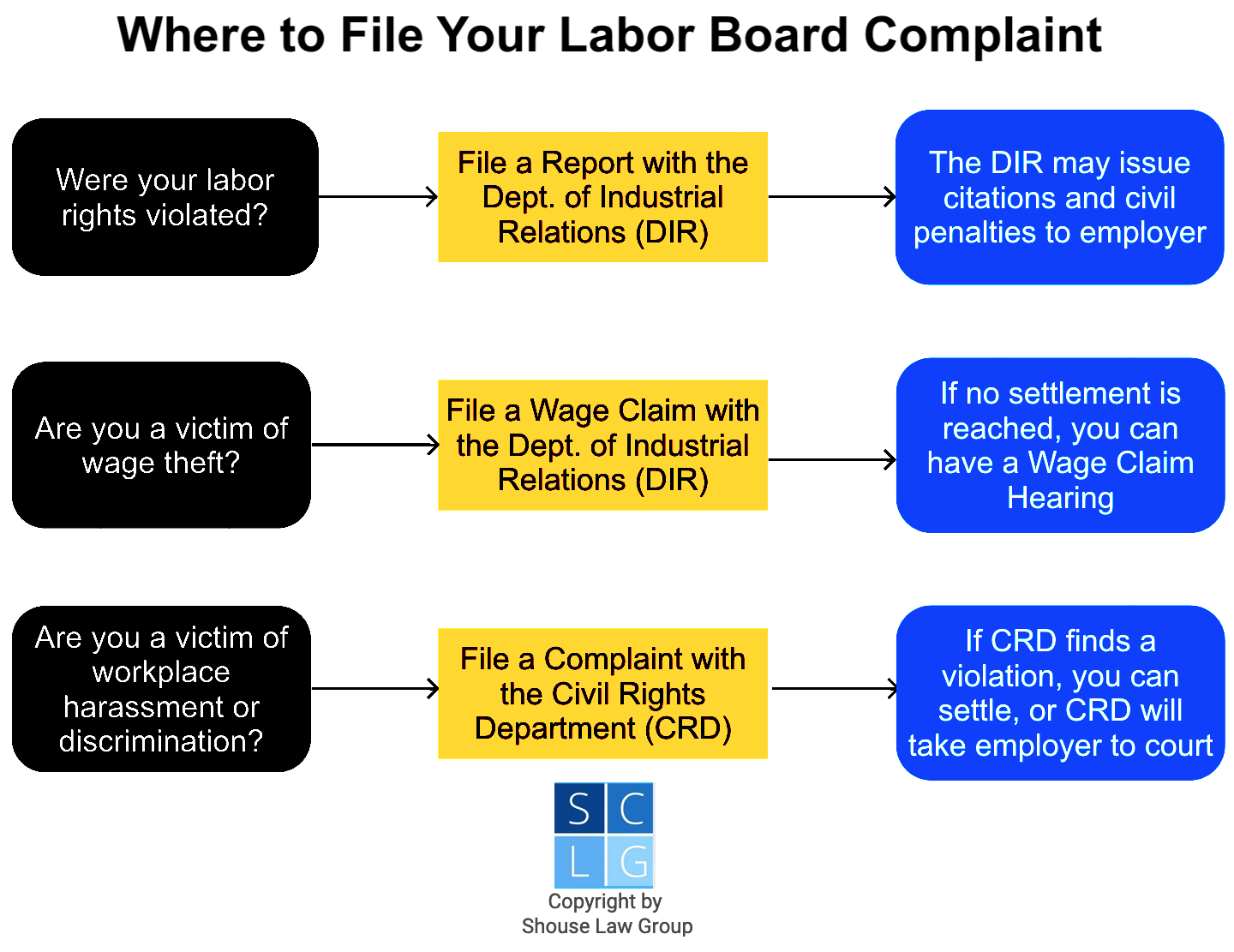
To Make a Wage Theft Complaint
To make a wage theft complaint with the California Labor Commissioner’s Office, click here. You will have to submit information requested by Form 1 (initial claim) and Form 55 (wage claim listing amounts owed by your employer per pay period). Be sure to have your pay stubs and W-2 Form (or 1099 Form) handy.
You will then have the opportunity to negotiate a resolution at a settlement conference. If no settlement is reached, then the Board will hold a wage claim hearing.
A wage claim hearing is similar to a trial, complete with the introduction of evidence and subpoenaed witnesses giving testimony. Within 15 days, the hearing officer will issue an Order, Decision or Award (ODA). Depending on the case, you may receive money not only for back pay for unpaid wages but also
- interest,
- attorneys’ fees, and
- penalties for liquidated damages, bounced checks, and late paychecks (waiting time penalties).
If either party appeals, the case is transferred to a superior court. If you win the hearing and any appeals, the court will issue a judgment.
At that point, it is usually your responsibility to collect the judgment. However, the Labor Commissioner has some power to place liens on an employer’s property to collect unpaid wages for successful claimants.
To Report a Labor Law Violation
To report a labor law violations with the California Labor Commissioner’s Office, click here. If you are claiming retaliation, you must complete Form RCI-1.
The Commissioner will then conduct an investigation. If they find a violation, they can issue citations and civil (monetary) penalties against your employer.
If you are owed back wages, you can file a wage theft complaint also (as discussed above).
To File a Discrimination or Harassment Complaint
To report workplace discrimination or harassment with the California Civil Rights Department (CRD), click here. Alternatively, you can file a complaint by mail or call the CRD at 800-884-1684.
The CRD will conduct an investigation. If they find a violation, you will have the opportunity to settle with your employer. Otherwise, the CRD can prosecute them in court.1
First Contact an Attorney
It is recommended you consult with a labor law attorney before filing a complaint. Attorneys are skilled at composing complaints to maximize the odds of success.
In the meantime, compile all the relevant evidence in your case. Examples include:
- pay statements,
- work emails and memos,
- voicemails and text messages,
- names and contact information of eyewitnesses,
- work schedules, and/or
- video or audio of your violation.
In our experience, it may be best to skip the complaint process and let us mail your employer a strongly worded demand letter. We find that once employers see you are lawyered up, they are more likely to negotiate a favorable resolution. In most cases, we can win you a large settlement without going to trial.

2. Common Complaints
The two most common employment complaints that get filed with California’s labor boards are:
- wage and hour complaints, and
- discrimination and harassment complaints.
Wage and Hour Complaints
As mentioned above, wage and hour complaints under the Labor Code are filed with the California Labor Commission.
Depending on whether you are “non-exempt” or not, common wage/hour violations under California law involve your employer:
- failing to pay the minimum wage;
- failing to pay “time and a half” overtime that you earned;
- failing to pay “double time” overtime that you earned;
- failing to issue you a timely final paycheck upon termination;
- refusing to provide you meal breaks;
- refusing to provide you rest periods;
- refusing to reimburse business expenses;
- refusing to reimburse mileage for driving from the office to a job site;
- failing to pay you your entire tips or tip pool portions;
- taking out deductions when you did not agree to it in writing;
- misclassifying you as exempt from wage/hour requirements; and
- misclassifying you as independent contractors.
Discrimination and Harassment Complaints
The California Fair Employment and Housing Act (FEHA) prohibits both:
- employment discrimination, and
- harassment.2
Discrimination Claims
As to discrimination, the FEHA makes it unlawful for any employer of five or more employees to discriminate based on:
- race,
- gender,
- religion,
- age,
- pregnancy,
- medical conditions,
- genetic information,
- marital status,
- sexual orientation, and
- veteran status.3
Discrimination can take many forms. Often, though, it involves your employer treating you differently as to:
- pay and earnings,
- working conditions,
- job duties,
- promotions and advancements, and
- the terms of your employment.
Harassment Claims
The FEHA prohibits both:
Non-sexual harassment is when:
- your employer creates, or allows, a hostile work environment, and
- it is one in which you are harassed on the basis of any of the above categories involving discrimination.5
Unlawful harassment can also be based on your immigration status, national origin, or ancestry.6
Sexual harassment comes in two forms under California State law:7
- “quid pro quo” harassment, which is when supervisors demand sexual favors for a workplace benefit.8
- “hostile work environment” harassment. You can bring this type of claim if:
- you are the recipient of unwelcome advances, conduct or comments,
- the harassment is in some sense based on your sex, and the harassment is either severe or pervasive enough to alter the conditions of employment.9

3. Labor Commission
The Labor Commissioner’s hearing officers basically review cases where you seek to recover lost wages or payments from your employer. Complaints can also involve wage theft and violations of state sick leave laws and reproductive loss leave laws.1
The Office also handles some retaliation claims. For instance, employers cannot fire, demote, reduce your pay, or suspend you just for filing a labor complaint. (Learn about whistleblower retaliation.)
The California Labor Commission is also known as the Division of Labor Standards Enforcement (DLSE). The DLSE falls under the Department of Industrial Relations and enforces the California Labor Code.
Alternatives to the California Labor Commissioner
You are not limited to filing wage and hour complaints with just the Labor Commission in California. If you have a legitimate wage/hour complaint, you can also raise these complaints by:
- filing a lawsuit in California Superior Court, and/or
- filing a wage claim with a federal agency of the United States.10
In our experience, it is best to bypass the Labor Commissioner’s complaint process by requesting a “right to sue” notice right away. This way, we can get started on litigating your case without any administrative delays.
The civil servants at the Labor Commissioner are overworked and lack the time and resources to pursue the best resolution for your case. As your attorneys, we would fight tirelessly for the most significant financial settlement allowable under the law to cover your unpaid compensation and all other damages you incurred, including pain and suffering.
Federal Claims
The Fair Labor Standards Act (FLSA) sets national rules for wages that employers must follow.11
The Act also sets forth a complaint process for you to follow if your employer violates these rules.12 Typically, the Wage and Hour Division of the U.S. Department of Labor handles these disputes.
In most cases, it is in your best interest to pursue your complaint through the California Labor Commissioner rather than the U.S. Department of Labor.
4. Civil Rights Department
You can bypass the Civil Rights Department (CRD) investigation process by asking them for a “right to sue” notice. At that point, you can file a lawsuit in Superior Court.
However, many claimants prefer to raise a discrimination or harassment complaint with the CRD because:
- it is cheaper in comparison to a civil lawsuit, which involves a lot of pretrial preparation and subpoenas
- the CRD can force employers to provide key evidence,
- the CRD can pursue an action against your employer in civil court, and
- the CRD can work with your employer to create more just employment policies and practices.
(To make a discrimination or harassment complaint with the CRD, click here.)
As an alternative to filing with the CRD, you can file a federal claim with the U.S. Equal Employment Opportunity Commission (EEOC.gov).13
5. Retaliation
“Retaliation” sometimes occurs after you raise a labor board complaint. Retaliation means that your employer or co-worker:
- takes some kind of unfavorable action against you, and
- does so just because you brought the labor board complaint.
This type of conduct is prohibited under both California law and federal law. Retaliation can take the form of:
- workplace harassment,
- workplace bullying,
- wrongful termination (or demotion),
- immigration retaliation, and
- failing to pay wages.
To file a retaliation complaint with the California Labor Commissioner, click here. You will have the opportunity to settle with your employer.
If no negotiation is reached, the Commissioner continues investigating and will determine whether your employer retaliated against you. They may then order that your employer:
- Reinstate you,
- Pay your back wages and benefits, and/or
- Pay civil penalties for their violations.
Effective January 1, 2024, there is a rebuttable presumption of retaliation if an employer takes adverse action against you within 90 days of you engaging in protected activity (like filing a labor board complaint).14
6. Statute of Limitations
In California, employment claims are subject to strict legal deadlines known as the “statute of limitations.” If you fail to file your complaint within the required time frame, you could permanently lose your right to recover your unpaid wages or receive compensation for your employer’s unlawful actions.
The exact deadline depends on the specific nature of your labor complaint:
Deadlines for Wage and Hour Claims (Filed with the Labor Commissioner)
Depending on the type of wage theft or labor code violation, your deadline to file will fall into one of four categories:
- 1-Year Deadline: For penalties related to bounced paychecks or if your employer refuses to allow you to inspect your pay stubs or payroll records.
- 2-Year Deadline: For unpaid wages resulting from a broken oral (spoken) promise to pay you more than the state minimum wage.
- 3-Year Deadline: For the most common wage theft claims. You have three years to file if your employer failed to pay minimum wage or overtime, denied you legally mandated meal and rest breaks, failed to provide paid sick leave, made illegal deductions from your paycheck, or failed to reimburse you for business expenses.
- 4-Year Deadline: For wage disputes that stem from a breach of a written employment contract.
Deadlines for Discrimination and Harassment Claims (Filed with the CRD)
If you are filing a complaint regarding workplace discrimination, sexual harassment, or retaliation under the Fair Employment and Housing Act (FEHA), you generally have three (3) years from the date the unlawful incident occurred to file a formal complaint with the California Civil Rights Department (CRD).
Deadlines for Equal Pay Act Violations
If you are filing a claim because you are being paid less than colleagues of a different sex, race, or ethnicity for doing substantially similar work, you have two (2) years from the date of the violation to file. However, if you can prove your employer’s actions were intentional (willful), that deadline is extended to three (3) years.
7. Contact the Labor Board
To contact the California Labor Commission, click here for a list of local phone numbers, email addresses, and frequently asked questions. The local Division of Labor Standards Enforcement (DLSE) offices are listed below.
| DLSE Offices | |
Bakersfield7718 Meany Ave |
San Diego7575 Metropolitan Dr., |
El Centro1550 W. Main St. |
San Francisco455 Golden Gate Ave., |
Fresno770 E. Shaw Avenue, |
San Jose100 Paseo de San Antonio, |
Long Beach1500 Hughes Way |
Santa Ana2 MacArthur Place |
Los Angeles320 W. Fourth Street, |
Santa Barbara411 E. Canon Perdido, |
Oakland1515 Clay Street, |
Santa Rosa50 “D” Street, |
Redding250 Hemsted Drive, |
Stockton31 E. Channel Street, |
Sacramento2031 Howe Avenue, |
Van Nuys6150 Van Nuys Blvd., |
Salinas950 E. Blanco Rd., |
Van Nuys – Entertainment Work Permits6150 Van Nuys Blvd., |
San Bernardino464 W. Fourth Street, |
AB 633- Garment Enforcement Unit320 W. Fourth Street, Click here for more information on garment worker claims. |
|
Oakland (Headquarters) |
|
To contact the Civil Rights Department (CRD), call 800-884-1684 or email [email protected]. The local offices are below:
| CRD Offices | |
Bakersfield4800 Stockdale Highway, Suite 215 |
Fresno1277 E. Alluvial Avenue, Suite 101 |
Elk Grove (Headquarters)
|
Los Angeles
|
Oakland555 12th Street, Suite 2050 |
Riverside1325 Spruce Street, Suite 320 |
Frequently Asked Questions
What are the exact rules for meal breaks, rest breaks, and overtime in California?
Under California labor laws, non-exempt employees are guaranteed specific breaks and overtime pay based on the hours they work:
- Rest Breaks: You are entitled to a paid, uninterrupted 10-minute rest break if you work more than 3.5 hours in a day, and a second 10-minute break if you work more than six hours. These cannot be combined with meal breaks.
- Meal Breaks: You are entitled to an unpaid, uninterrupted 30-minute meal break if you work more than five hours (which must start before the end of your fifth hour). A second 30-minute meal break is required if you work more than 10 hours.
- Overtime: You must be paid “time and a half” if you work more than eight hours in a single day, more than 40 hours in a week, or if you work seven consecutive days in a workweek. “Double time” applies if you work more than 12 hours in a day or more than eight hours on your seventh consecutive workday.
When is my employer required to give me my final paycheck?
The deadline for your final paycheck depends on how your employment ended:
- If you are fired or laid off: Your employer must give you your final paycheck immediately on your last day of work.
- If you resign with notice: If you give your employer at least 72 hours of advance notice before quitting, you must receive your final paycheck on your last day.
- If you resign without notice: If you quit without giving 72 hours’ notice, your employer has exactly 72 hours from the time you quit to provide your final pay.
Your final paycheck must include all unpaid wages as well as any accrued, unused vacation time (though it does not need to include unused sick leave).
Can my employer deduct money from my paycheck or take my tips?
No. It is illegal for an employer to deduct money from your paycheck without your explicit, written consent—even if they loaned you money. Additionally, managers and supervisors are strictly prohibited from taking any portion of an employee’s tips or participating in an employee tip pool.
If you are required to use your personal vehicle to drive between job sites, your employer must also reimburse you for mileage (the IRS standard mileage rate for 2026 is 72.5 cents per mile).
How long does the Labor Board complaint process actually take?
While the Labor Commissioner’s Office does not charge any filing fees, the process can be quite slow due to state backlogs. Once you file your complaint correctly, you will typically wait three to 12 months just to receive a notice for your initial settlement conference.
If your case does not settle at the conference, it can take anywhere from three to 24 months to get a date for your formal hearing (trial). Even after the judge issues their decision (the Order, Decision, or Award), it can sometimes take months for the formal paperwork to be mailed to the parties.
Can I file a wage complaint if I am an undocumented immigrant?
Yes. The California Labor Commissioner explicitly protects the wage rights of all workers in the state, regardless of their immigration status. It is strictly illegal for an employer to threaten you, retaliate against you, or report you based on your immigration status just because you filed a claim for unpaid wages.
Additional Resources
For more information, refer to the following:
- Report a Labor Violation to the California Labor Commissioner – Handbook by the Bureau of Field Enforcement.
- Fact sheet on how California law prohibits workplace discrimination and harassment – Provided by the Civil Rights Department.
- California Paycheck Calculator For Salary & Hourly Payment – Free online tool from Forbes.
- As more Californians allege on-the-job violations, labor groups say bosses retaliate – Article by CalMatters.
- Resources to Fight Harassment in the Workplace – Informational list compiled by non-profit organization Project WHEN.
Legal References:
- California Labor Code section 98a. See also Labor Code sections 21, 79, 90, 90.5, 98, 200, 201, 202, 203, 204, 204a, 204b, 204c, 207, 221, 226.7, 227, 227.3, 510, 558, 1182.12, 1197, 2802. Cal. Code Regs., tit. 8, 11040 & 11070. See also Crestwood Behavioral Health, Inc. v. Lacy (, 2021) 70 Cal. App. 5th 560. SB 588 (2015). California Government Code 12945.6. See also, for example, Contreras v. Green Thumb Produce, Inc. (2025) 116 Cal. App. 5th 1251.
- California Government Code 12900, 12920, 12940 & 12960. See also Labor Code section 98.6. 29 U.S.C. § 631. Cal. Code Regs., tit. 8, 11040 & 11070.
- California Government Code 12940a.
- California Government Code 12940.
- See same.
- See same.
- Holmes v. Petrovich Development Co. (2011) 191 Cal.App.4th 1047.
- Mogilefsky v. Superior Court (1993) 20 Cal.App.4th 1409.
- Hughes v. Pair (2009) 46 Cal.4th 1035.
- See, for example, Reynolds v. Bement (2005) 36 Cal.4th 1075.
- 29 U.S.C. 201–219.
- 29 U.S.C. 211.
- California Government Code 12965 GC. As to federal law, Title VII of the Civil Rights Act of 1964 protects certain groups from discrimination. Federal law prohibits discrimination on the same basis as set forth under California’s employment laws.
- SB-497 (2023).