
In California, a sample demand letter for unpaid wages informs your employer of your missed payments and of your willingness to take legal action to recover them. Demand letters should include details about
- you (the worker),
- your employer, and
- your unpaid wages.
It should be formal and strongly worded, but also polite and stick to the facts.
What does a sample demand letter or template look like?
Every demand letter is unique. They will all include different information about your employer, you, and the circumstances that led to the lack of payment. However, they should all include certain elements. An example of a demand letter for unpaid wages can look like this:
|
What is a demand letter for unpaid wages?
A demand letter for unpaid wages is a formal request to your employer. It informs your employer that wages were not paid and remain outstanding. It tells your employer how to pay the wages and when the deadline is to do so. It also lets your employer know that you are willing to take further legal action to recover the unpaid wages if you do not receive them by the deadline.
For former employees, sending a demand letter is often the first move in a series of legal actions that may be required to recover your unpaid wages. In some cases, your former employer’s failure to pay is an honest mistake. If that is the case, your formal demand letter should spur them into action and prompt them to pay the amount owed quickly. If that is not the case, your demand letter puts a deadline on your former employer’s uncontested refusal to pay. It also notifies your former employer that you are willing to go further to recover your payment.
For current employees, issuing a demand letter for unpaid wages can serve two purposes. It can:
- try to collect the unpaid wages, and
- protect your job.
Filing a demand letter can protect your job because you generally have a legal right to receive the wages that you have earned. Demanding payment is usually a legally protected right. Firing you for exercising a legally protected right can constitute retaliation. This can be the grounds for a wrongful termination lawsuit.

What details should an unpaid wages demand letter include?
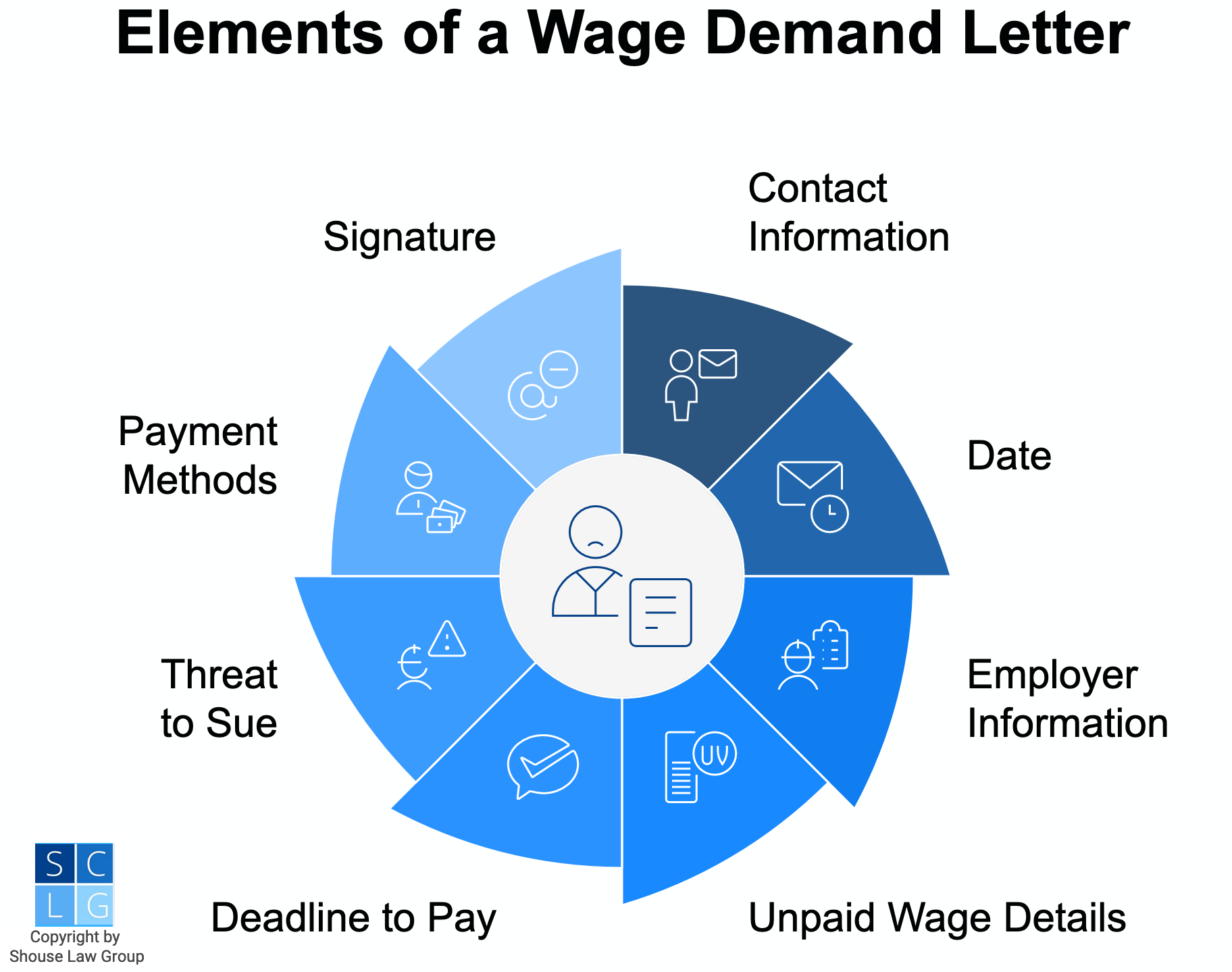
Demand letters for unpaid wages should include the following eight elements:
- your personal and contact information,
- the date the letter is sent,
- information about your employer,
- details describing the wages that are owed,
- a deadline for the receipt of those unpaid wages,
- a description of the actions that you will take if the wages are not paid by the deadline,
- how your employer can pay the wages, and
- your signature.
The letter should include these elements using a strong but professional tone. The letter does not need to be complex or verbose. It should be written in simple and straightforward language.
The sample letter above includes all of these elements and an appropriate tone.
Information about you
Your demand letter should include your personal information and contact information. It should include your:
- name,
- address,
- email address, and
- phone number.
This needs to be up-to-date and current. Old contact information will add an obstacle to the communication that the letter aims to initiate.
This information often goes right at the top of the page, in the header. The format of the letter is not important, but this personal information is often aligned to the right of the page at the top. It may also be included again at the bottom, beneath your signature.
The date the letter is sent
Including the date the letter is sent can show that your employer has been given ample time to pay you. It also shows that the deadline in your demand letter is reasonably far off and that your employer has plenty of time to make the payment before the deadline expires.
Your employer’s information
Including accurate information about your employer can help show that your letter went to the right place. It should generally include at least:
- the name of your supervisor, and
- your employer’s address.
It does not need to include your employer’s contact information. You will generally already have that, and providing it will not help your employer make the payment.
Details of the unpaid wages
This is perhaps the most important part of your demand letter. You should always give an exact dollar amount for your unpaid wages.
You may also want to include a calculation showing how you arrived at this amount. For example, if you are an hourly worker, you may want to list the dates and the number of hours you worked without pay, including hours that required overtime pay.
If you have other types of wages, the calculation may be more complex. Prior pay stubs may be useful if your employment is stable or if you are salaried.
Providing more information is unnecessary and may undermine your demand letter. If additional information is included – like what work was performed on each day – and it turns out to be inaccurate, your employer may point to the error as a reason to doubt the veracity of your claim.
The deadline
All demand letters for unpaid wages should include a deadline. If a deadline is not included, there is no set point in time at which you can escalate your payment demands. The deadline also urges your employer to act before it expires, or risk further legal action.
You should pick a deadline that is not so far in the future that it will unduly delay payment, but also not so soon that your employer can claim that it was unreasonable to meet.
If you are a former employee, the deadline should also account for how much time your former employer has to pay wages after termination. The federal Fair Labor Standards Act (FLSA) does not answer this question, but many state laws do. In California, employers must pay your final wages immediately if you are
- fired or
- quit with more than 72 hours’ advance notice.
If you quit without notice, your last paycheck must be paid within 72 hours.1
Setting a deadline of 1 to 2 weeks, or 5 to 10 business or working days, is often ideal.
Further legal action
Your demand letter should state what you intend to do if your unpaid wages are not paid by the deadline. This can include:
- sending the debt to a collection agency,
- filing a claim with the state labor commissioner or the Department of Labor, or
- filing a lawsuit for unpaid wages or wage theft.
You should be prepared to follow through on whatever legal action you mention in your demand letter.
How your employer can pay
It is often useful to explicitly state how your employer can rectify the situation. This generally includes restating your address and urging your employer to send a check for the unpaid wages there.
Your signature
Signing your demand letter can show your employer that you are behind the letter.
How should I send the letter?
Sending your demand letter is not as simple as dropping it in the mailbox. Additional precautions should be taken. Doing so soon after wages have become past due is important to comply with the statute of limitations.
You should keep a copy of your demand letter for your own records. This can be helpful if your employer tries to deny that the letter existed.
Your demand letter should be sent so that a record of receipt is created. You should consider mailing it:
- via Certified Mail, or
- with return receipt.
The Certified Mail receipt can prove that your employer received the letter.
What happens if my employer does not pay?
If your employer has not paid by the deadline, you should take the legal action outlined in your demand letter. A lawyer with experience in employment law can help file a wage claim in superior court, in a small claims court, or with the appropriate government agency. Getting legal services and legal advice from an attorney at a reputable law firm can drastically increase your odds of recovering your unpaid wages.
Additional Reading
For more in-depth information, refer to these scholarly articles:
- A Shot across the Bow: How to Write an Effective Demand Letter – J. Ass’n Legal Writing Directors.
- Fight Wage Theft with Direct Action – Green Social Thought: A Magazine of Synthesis & Regeneration.
- How to Deal with Wage and Hour Class Action Lawsuits – Compensation & Benefits Review.
- Same Law, Different Day: A Survey of the Last Thirty Years of Wage Litigation and Its Impact on Low-Wage Workers – Hofstra Labor & Empirical Law Journal.
- Welcome to the Working Week: The Minimum Pleading Standard for Unpaid Overtime Claims under the Fair Labor Standards Act of 1938 – University Cincinnati Law Review.
- Hollow Victories: The Crisis in Collecting Unpaid Wages for California’s Workers – UCLA: Institute for Research on Labor and Employment.