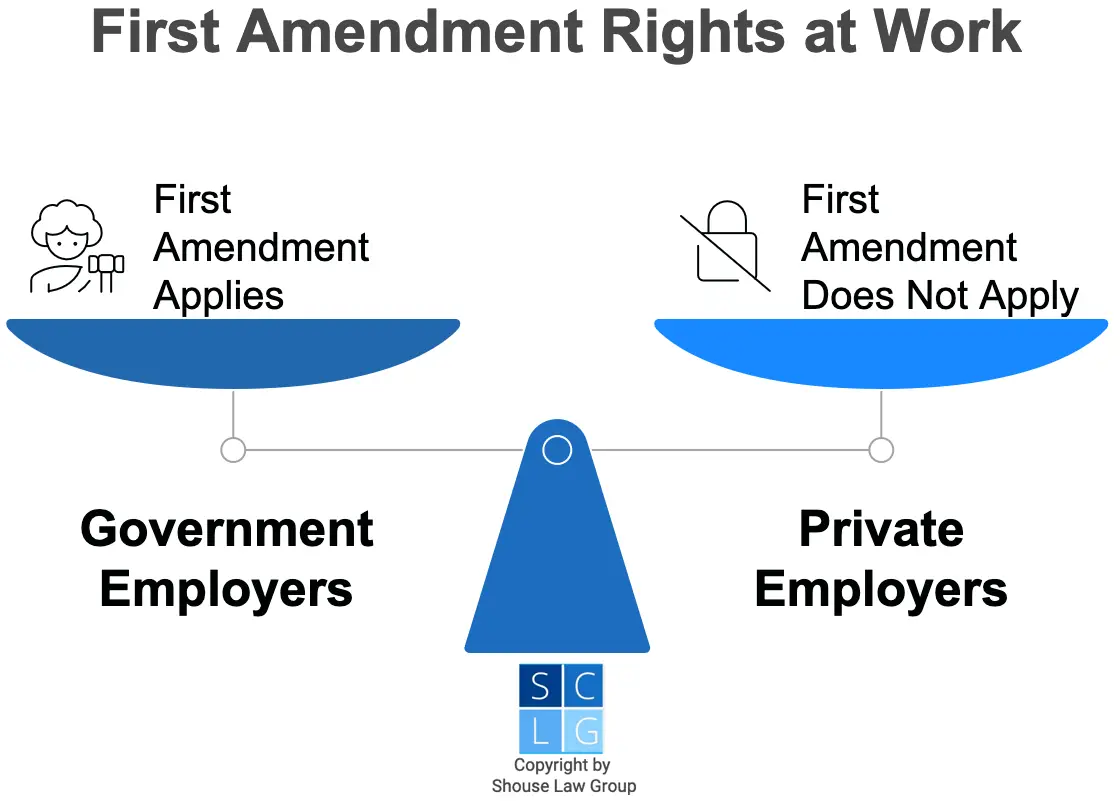
You generally only have First Amendment rights at work if your employer is the government. The First Amendment does not apply to private actors, such as private businesses.
However, some state and federal employment laws protect some of your speech in the workplace. If you are a public employee, your speech can still be limited so as not to disrupt workplace efficiency.
Continue reading to learn more about workplace free speech rights, and also listen to our informative podcast:
Private Sector Employees
If you work for a private employer such as a corporation, business, or non-profit, then the First Amendment does not protect your speech in the workplace. Your employer can restrict your rights to free speech without implicating the First Amendment.
However, the federal National Labor Relations Act (NLRA) and Title VII of the Civil Rights Act of 1964 – which apply across the country – do protect certain types of speech in the workplace.
NLRA
The NLRA protects your “concerted activities” for “mutual aid or protection.”1 This includes speech between employees or co-workers about their working conditions, including discussions about:
- unionizing,
- workplace safety,
- wages, and
- collective bargaining.
According to the National Labor Relations Board (NLRB), this employment right stretches to include posts on social media, even if those posts include other types of speech that do not have workplace free speech protections, including profanity.2
Title VII
Title VII, meanwhile, protects your right to speak out against discrimination or harassment in the workplace. If you make a claim of harassment or discrimination, you are protected from adverse employment actions.
If your employer takes materially adverse action against you for making the claim, it can amount to retaliation.3
California Law
Like the federal law Title VII, California’s Fair Employment and Housing Act (FEHA) protects public and private employees from retaliation for speaking out against workplace harassment and discrimination.4 However, two other laws go further than federal law.
Firstly, California Labor Code section 1101 LAB prohibits employers, including private employers, from making or enforcing workplace rules that either:
- forbid or prevent employees from running for office or participating in politics, or
- control or direct their employees’ political affiliations or activities.5
Secondly, California Labor Code section 1102 LAB prohibits employers from threatening to discharge workers in order to influence their political activity.6
Limitations of the Law
Both California Labor Code sections 1101 and 1102 require showing that your employer acted against you for a political motive. If you suffered an adverse employment action, but it was an apolitical business decision, it does not violate the law.
For example: David has a full-time job. His employer has a policy that workers cannot take on activities outside of the workplace that would require a large time commitment without the employer’s prior approval. David tells his supervisor that he wants to run for public office on the board of supervisors for Los Angeles County. This position is a nearly full-time commitment. His supervisor forbids him from running. David ignores him, runs for office, wins the election, and then gets fired.7
Additionally, these California labor laws only apply to your political activity that happens away from work when you are off-duty. Private employers can likely still make and enforce rules about political conduct that happens on the worksite.8
Recent initiatives to expand free speech rights in the workplace by making political affiliation a protected class under anti-discrimination laws have failed.9
Public Sector Employees
Because the First Amendment protects your free speech rights from government suppression, if you work in the public sector, it applies to your workplace.
However, those employee rights are not absolute. In order to be protected from workplace repercussions, a public employee’s speech must be:
- given as a citizen, not as a part of your official duties as a public employee, and
- about a matter of public concern.10
Some examples of public employees include:
- teachers or administrators in public schools,
- police officers,
- firefighters,
- doctors and other employees at public hospitals, and
- employees in federal, state, or local government agencies.
You can benefit from the First Amendment’s protections even if you are not directly employed by the government. Some examples include:
- employees of companies that receive government contracts,
- private employees that provide services to a public agency, like a court or school, and
- volunteers that provide public services.11

Speaking as a Private Citizen
Government employees speak as private citizens when what they say is not a part of their job. If you do not have an official duty to make the statements you are making, then you are speaking as a private citizen. Some factors include whether:
- you confined your communication within your chain of command or addressed them to the public,
- the subject matter was within your job duties,
- you spoke in direct contravention to your supervisor’s orders, and
- the subject matter was about broad concerns over corruption or systemic abuse that was not confined to your particular department.12
Your speech is a matter of public concern if it relates to a political, social, or other community concern. According to the Supreme Court of the United States, though, you only have First Amendment protection to make statements that do not threaten your public employer’s interest in running an efficient workplace.13
Employer Retaliation
If your government employer takes disciplinary action against you for protected speech, it can amount to retaliation. It can also violate your constitutional rights for freedom of speech.
Showing that you suffered an adverse employment action and that your statements were a substantial or motivating factor for it can take the legal advice and representation of a lawyer.
In Conclusion
If the government is your employer, you have free speech rights at work thanks to the First Amendment. However, those rights limited: They can be restricted if your words interfere with how things run at work.
If a private company is your employer, then the First Amendment does not protect your speech. However, there are federal and state laws that help protect you if you’re talking about things like unionizing, safety, or discrimination.
Knowing the difference between these rules is important so you understand what you can and cannot say while on the job.
Additional Reading
For more information, refer to the following scholarly articles:
- Free Speech Rights at Work: Resolving the Differences between Practice and Liberal Principle – Industrial Law Journal.
- Free Speech and Due Process in the Workplace – Labor and the Constitution.
- Free Speech Rights That Work at Work: From the First Amendment to Due Process – UCLA Law Review.
- Whistleblowers, Insubordination, and Employee Rights of Free Speech – Labor Law Journal.
- Free Speech Rights in Private Employment? The First Amendment, the Present Patchwork, and a Balanced Improvement – First Amendment Law Review.
Legal References:
- 29 USC 157. The first five words of the First Amendment are “Congress shall make no law”. This is an important limitation of the Bill of Rights: They only protect your rights from government suppression. This is called the Constitution’s “state action requirement.” If there is no action by the state – whether in the form of the local, state, or federal government – then the Bill of Rights does not apply.
- National Labor Relations Board v. Pier Sixty, LLC, 855 F.3d 115 (2d Cir. 2017).
- 42 USC 2000e-3(a).
- California Government Code 12940 GOV.
- California Labor Code 1101 LAB.
- California Labor Code 1102 LAB.
- Facts from Couch v. Morgan Stanley & Co. Inc., 656 Fed. App’x 841 (9th Cir. 2016).
- Ali v. L.A. Focus Publication, 112 Cal.App.4th 1477 (2003).
- California Senate Bill 238.
- Manual of Model Civil Jury Instructions 9.9. See also Garcetti v. Ceballos, 547 U.S. 410 (2006).
- Riley’s American Heritage Farms v. Elsasser, 32 F.4th 707 (9th Cir. 2022).
- Manual of Model Civil Jury Instructions 9.10. See also Dahlia v. Rodriguez, 735 F.3d 1060 (9th Cir. 2013).
- Pickering v. Board of Education, 391 U.S. 563 (1968) and Connick v. Myers, 461 U.S. 138 (1983). See also Adams v. County of Sacramento (9th Cir. 2024) 116 F.4th 1004.