A right to sue letter by the Equal Employment Opportunity Commission (EEOC) gives you permission to file your employment discrimination lawsuit in federal court. Receiving a right to sue letter means that you have exhausted your administrative remedies, which is often necessary for bringing a private lawsuit.
It is as if the EEOC says to you:
“We have done what we can in this matter, and we are handing the ball over to you. If you and your lawyer want to bring a lawsuit, at this point, you have our blessing.”
In short, the right to sue letter (also called a “notice of the right to sue”) means that the EEOC will not assist in your case any longer. You will have 90 days to file your lawsuit.
How do I sue for Employment Discrimination?
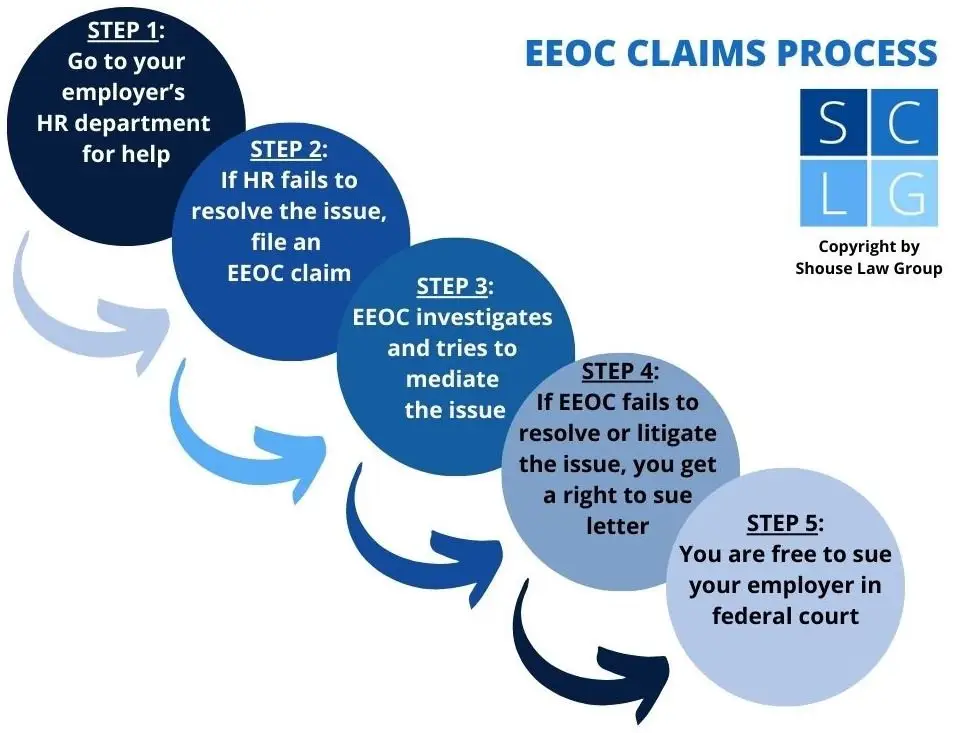
Go to Human Resources
If you have been discriminated against or harassed in the workplace, go to your employer’s human resources department first in the hopes they can resolve the issue. This step is often mandated by your employee contract or handbook.
Note that if your discrimination claim involves harassment by a non-supervisor, bringing your claim to HR is essential. Generally, you can hold your employer liable for non-supervisor harassment only if the employer:
- knew or should have known about the harassment and
- failed to take immediate and appropriate action to stop it.1
Taking your discrimination claim to the human resources department puts your employer on notice that it is happening. If your employer does not respond appropriately, it can strengthen your case.
File a Claim with the EEOC
If you are unsatisfied with your employer’s response, you can file a discrimination claim with the EEOC. If your state’s anti-discrimination laws provide greater protections, you may also want to file a charge with your state agency.
The EEOC claim has to be filed within 180 days of the wrongful or discriminatory conduct.2 (However, if you are also going to file a state charge for employment discrimination, this deadline is extended to 300 days.3)
Once the EEOC receives your discrimination charge, they will investigate your claim. This generally involves an EEOC investigator:
- reviewing employment documents,
- reading workplace complaints,
- interviewing witnesses,
- taking a statement from you about your experiences, and
- receiving a rebuttal from your employer.
Wait for the EEOC’s Response
Ultimately the EEOC will do one of two things.
The first is to issue you a “Dismissal and Notice of Rights.” This means the EEOC is choosing not to move forward with your claim, but you have the “right to sue” in federal court.
Alternatively, the EEOC will issue you a “Letter of Determination” (also called a “Cause Determination.”) This means the EEOC investigator determined you have a valid claim and will suggest mediation between you and your employer.
If mediation does not work – or if you decline mediation – the EEOC gives you a right to sue letter. In certain cases, the EEOC will even file a lawsuit on your behalf.
File a Lawsuit
Once you have the right to sue letter from the EEOC, you are free to file a lawsuit in federal court. Be aware that getting a right to sue letter is not an indicator of what the court will do if you decide to bring a lawsuit: Only the judge or jury in your case can decide that.
In some cases, your employment attorney can demand a right to sue letter right after filing the charge with the EEOC. This can speed up the case and bring it to court more quickly.
Note that if the EEOC investigation is dragging on for more than 180 days, you can ask for a right to sue letter right away. It does not matter that the investigation is unfinished.
In most cases, however, we recommend letting the EEOC case play out. If the EEOC eventually issues a “Letter of Determination” – meaning that they believe you have valid claim – that would serve as valuable evidence should your case eventually go to court.

How long do I have to sue?
Once you have received your right to sue letter from the EEOC, you have only 90 days to file your discrimination or harassment lawsuit in court.4
Do I always need a right to sue letter?
Most claims of workplace discrimination require a right to sue letter before you can file your claim in court. However, there are exceptions if your case involves either:
- Violations of the Equal Pay Act or
- Age discrimination under the Age Discrimination in Employment Act of 1967 (ADEA).
Equal Pay Act
The Equal Pay Act requires men and women receive equal pay for equal work. The Act amended the Fair Labor Standards Act (FLSA).5
These lawsuits can be filed in court without going through the administrative remedies provided by the EEOC. You have
- 2 years from the day that the pay discrimination took place to file suit or
- 3 years if the discrimination was willful.6
Age Discrimination in Employment Act
For age discrimination lawsuits under the ADEA, do not need to first obtain a right to sue letter from the EEOC. However, you do still need to file a charge with the EEOC before suing your employer.
Once you have filed the charge with the EEOC, you can initiate your lawsuit within 60 days.7
What is workplace discrimination?
Workplace discrimination is disparate treatment that is based on a protected class.8
Numerous state and federal employment laws forbid discrimination in the workplace. Some of the most important federal laws are:
- Title VII of the Civil Rights Act of 1964,
- Americans with Disabilities Act (ADA),
- Pregnancy Discrimination Act (PDA),
- Equal Pay Act (EPA), and
- Age Discrimination in Employment Act (ADEA).
Protected Classes
Altogether, these laws provide legal protections to workers who belong to the following protected classes:
- race,
- national origin,
- ancestry,
- genetic information,
- color,
- religion,
- sex,
- gender,
- gender expression and identity,
- sexual orientation,
- pregnancy,
- age,
- physical or mental disability,
- marital status, and
- military or veteran status.
Discriminatory Behavior
Disparate treatment can become a type of discrimination if it amounts to:
- a hostile work environment,
- wrongful termination, or
- harassment (including sexual harassment and non-sexual harassment).
Note that there are two types of workplace sexual harassment:
- Hostile Work Environment (HWE) Sexual Harassment, which occurs when the harassment is based on your sex and is severe enough to alter your conditions of employment. It does not matter whether the harassment comes from a boss, co-worker, inferior, third-party, or a customer.
- Quid Pro Quo Sexual Harassment, which occurs when your boss conditions workplace benefits on you giving sexual favors, and your refusal causes your boss to carry out with their threat (such as demoting or firing you).
Either type is grounds for an EEOC claim and, if necessary, a lawsuit.
A Lawyer Can Help
If you have been subjected to this kind of treatment because you belong to a protected class, you may have a discrimination case. You should strongly consider getting the help of an experienced employment lawyer.
With the legal advice of a discrimination attorney from a good law firm, you can go through the necessary steps to sue your employer in federal or state court. An experienced attorney can help you first file your charge with the EEOC or the appropriate state agency before the time limit has expired.
Additional Reading
For more in-depth information, refer to these scholarly articles:
- Is the Honeymoon Over – The Fate of the EEOC and the Early Right-To-Sue Letter – Washburn Law Journal.
- Equal Opportunity: Federal Employees’ Right to Sue on Title VII and Tort Claims – University of Chicago Law Review.
- Analysis of the EEOC’s Issuance of Early Right-to-Sue-Letters: Does it Promote Judicial Efficiency or Encourage Administrative Incompetence – University of Pennsylvania Law Review.
- When Will It End? Whether the Right-to-Sue Letter Effectively Limits the EEOC’s Investigative Authority – University of Kansas Law Review.
- Master of Its Own Case: EEOC Investigations after Issuing a Right-to-sue Notice – University of Chicago Law Review.
Legal References:
- See California Government Code 12940.
- 42 USC 2000e-5(e)(1).
- Same.
- 42 USC 2000e-5(f)(1). See, for example, Defries v. Union Pacific Pac. R.R. Co. (9th Cir., 2024) 104 F.4th 1091.
- 29 USC 206(d).
- 29 USC 255(a).
- 29 CFR 1626.18(b).
- See Teamsters v. United States (1977) 97 S.Ct. 1843.